Market & Competitive Intelligence Report 2026: AI Edition
Over 100 intelligence practitioners on what AI changed: more output, more review, and harder questions about what you can stake a decision on.
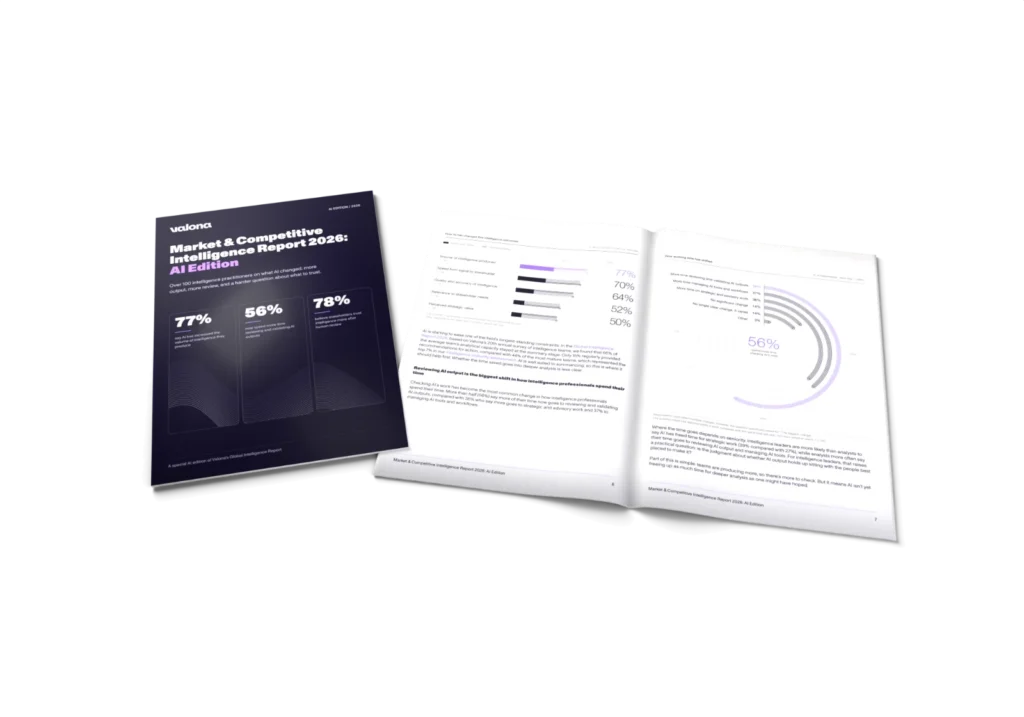
From a survey of 103 competitive and market intelligence practitioners, 17 August – 13 September 2026.
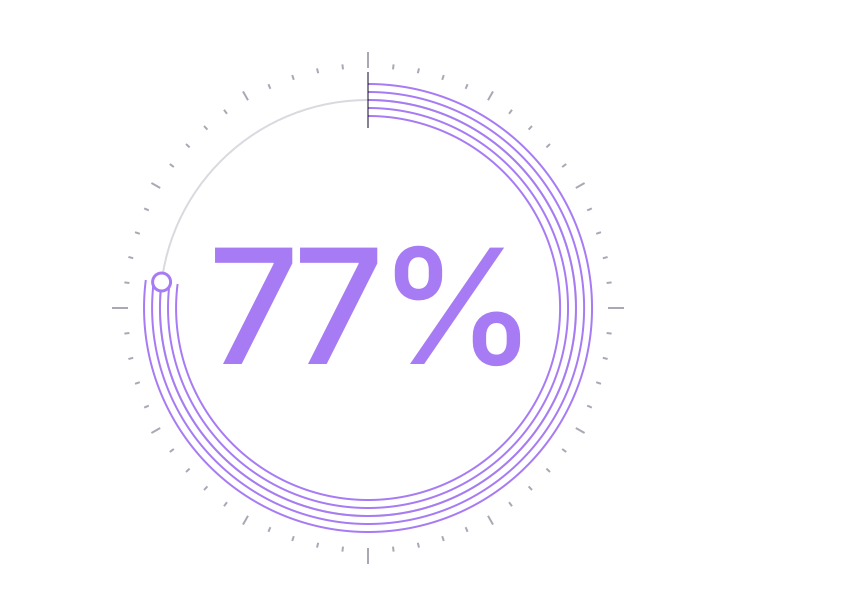
77% say AI has increased the volume of intelligence they produce
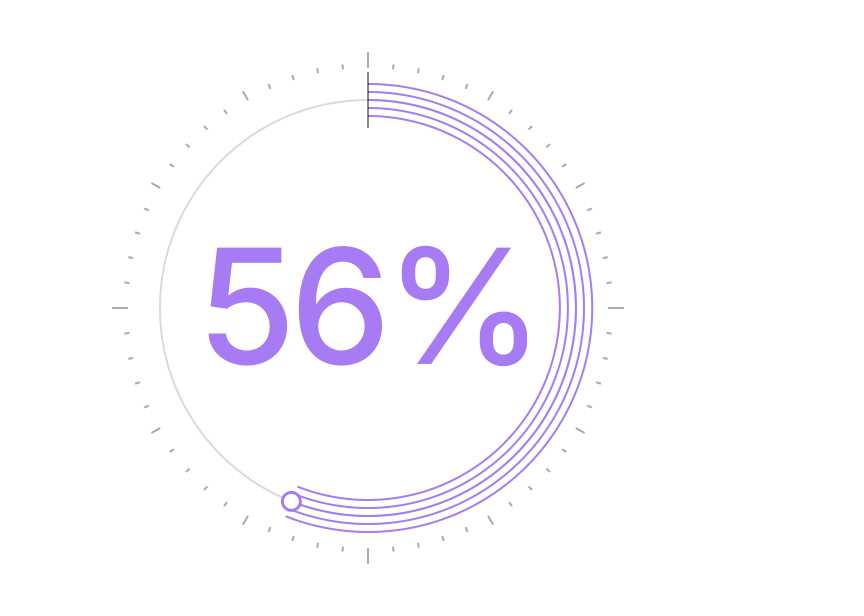
56% now spend more time reviewing and validating AI outputs
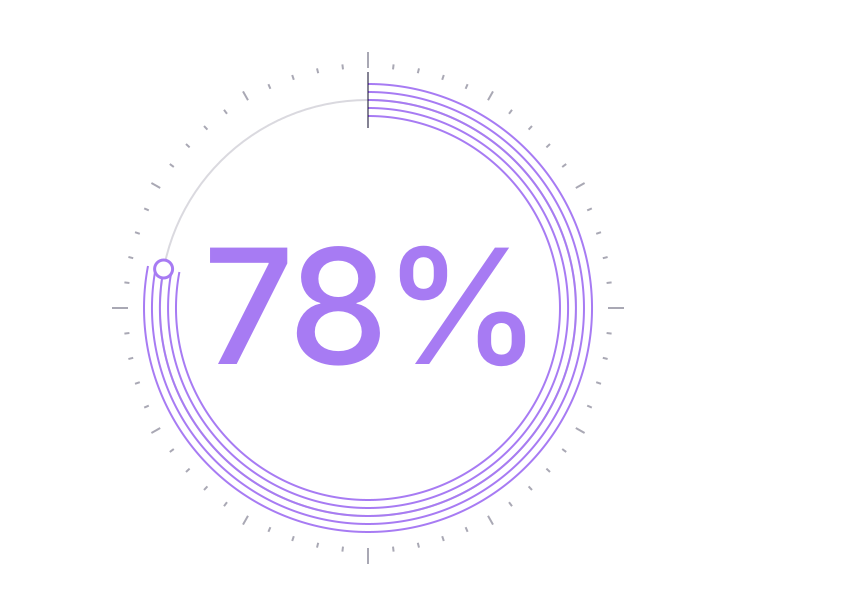
78% believe stakeholders trust intelligence more after human review
Three key findings on AI in competitive intelligence
Review is becoming a larger part of intelligence work
While 77% of respondents report increased output, 56% say the main change in their work is that they now spend more time reviewing and validating AI results. Gains in relevance and strategic value are less widespread than gains in volume and speed: AI is making it easier to produce intelligence, not necessarily to make it matter.
An analysis can pass a fact-check and still give an inaccurate picture
Respondents described missing competitors, comparisons built on incompatible figures and global data used to answer local-market questions. None of these shows up when you check claims one at a time. We’ve defined six criteria for reliable AI-enabled intelligence: from traceable evidence to proportionate review.
Intelligence teams can shape how reliable AI research is across the business
Rather than reviewing every answer, intelligence teams can make validated sources and relevant expertise easier to access, and help colleagues recognize when specialist scrutiny is needed. That includes understanding the question before research begins and learning what happened after the findings were delivered.
AI is helping market and competitive intelligence teams produce more and deliver faster: 77% say it has increased the volume of intelligence they produce, and 70% say it reaches stakeholders sooner. Time savings were the benefit respondents named most often. 64% also say the quality and accuracy of their intelligence has improved, though some of that likely reflects the extra review the teams now do.
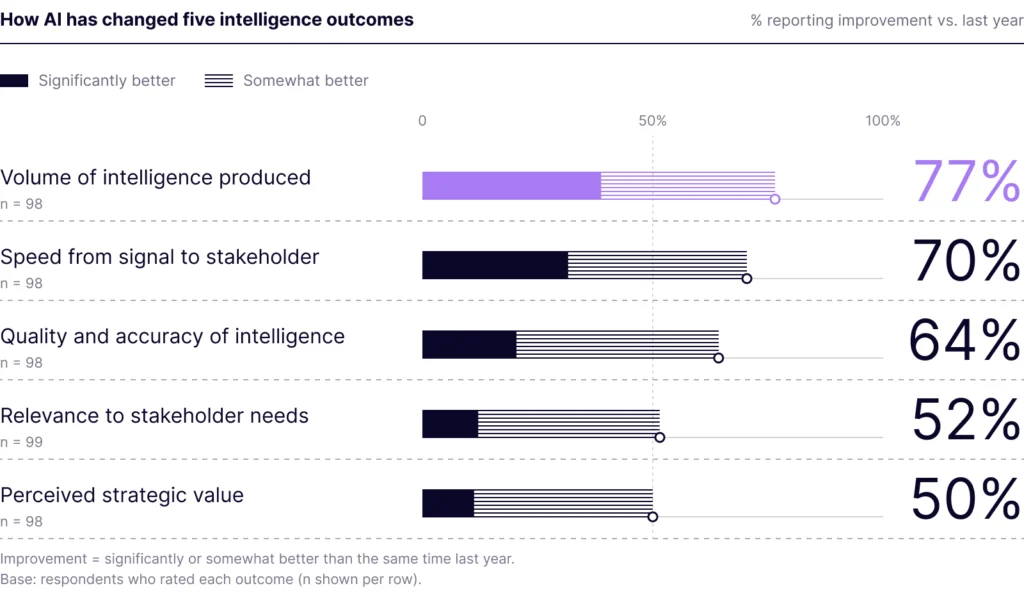
Reviewing AI output is the biggest shift in how intelligence professionals spend their time
Asked what has changed most in how they spend their time compared with a year ago, more than half (56%) named reviewing and validating AI outputs. Fewer pointed to managing AI tools and workflows (37%) or to strategic and advisory work (36%). Only 14% said nothing significant had changed.
Part of this is simple: teams are producing more, so there’s more to check. But it means AI isn’t yet freeing up as much time for deeper analysis as one might have hoped.
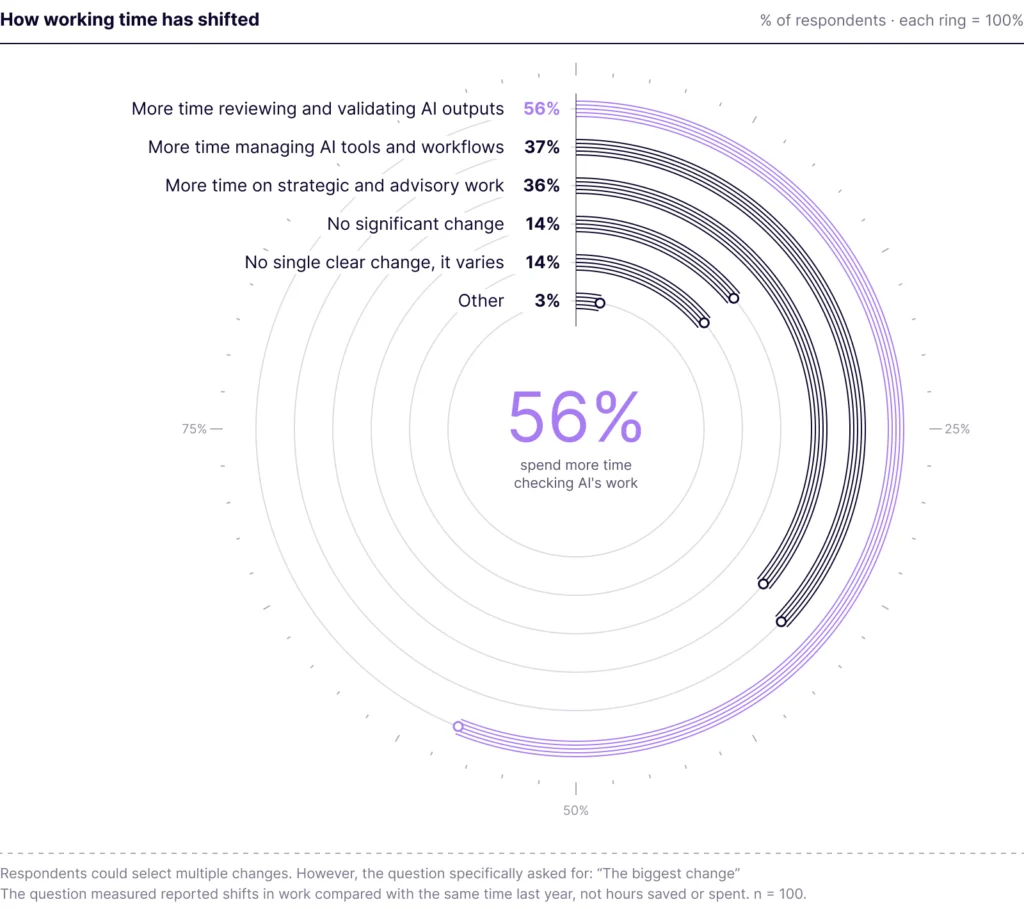
AI improves intelligence output more than strategic value
AI’s gains are concentrated in volume and speed rather than strategic value. 77% of respondents say AI has increased the volume of intelligence they produce, and 39% call the increase significant. By comparison, 52% report better relevance to stakeholder needs (12% significantly) and 50% a higher perceived strategic value (11% significantly).
A senior strategy executive we interviewed described the problem from the receiving end: “too much information,” and “a lot of time asking, ‘So what?'”
That leaves two challenges for anyone relying on AI-enabled intelligence: making sure an analysis is reliable, and keeping it connected to the decision it’s meant to support.
Hallucinations, it turns out, are only part of the problem. Respondents often named invented facts and sources as a reason to review AI output, and a fact-check is designed to catch those. But many of the problems they described came from how an analysis was put together: what it covered, what it compared, which market it described. Those are harder to spot, because every fact can check out while the overall picture is still wrong.
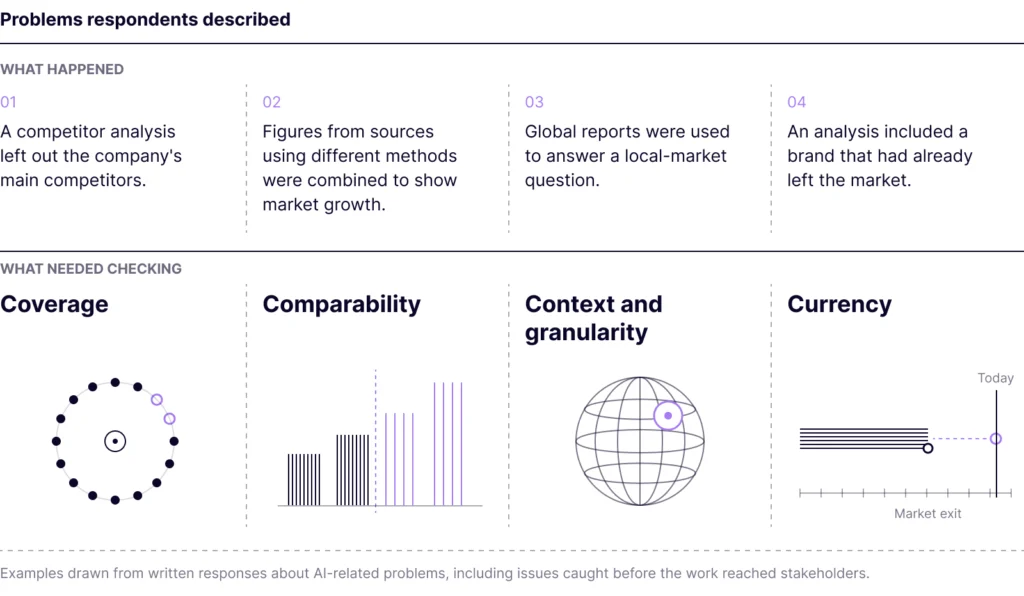
“NEARLY caused a problem, but we picked it up. Key brands missing, brand in intel that had left [the] country, pricing data completely out, market size out. Referencing global reports, which are not granular enough for the local market.”
— Intelligence leader, automotive manufacturing
A missing competitor means the analysis describes part of the market as if it were all of it. Figures built on different methods can each have a source and still point to a trend the evidence doesn’t support. Global data can be on the right topic at the wrong level of detail. An outdated source can be cited accurately and still describe a market that no longer exists. None of these shows up when you check claims one at a time.
AI answers the question you typed, not always the one you meant
The decision an analysis supports determines what it needs to cover: the time horizon, the market and the segment. Getting the question right has always been part of intelligence work. AI adds a new risk: it answers fluently and confidently and won’t necessarily ask you what you meant.
“…did not sufficiently consider the relevant context or ask the necessary clarifying questions. It therefore reached an incorrect conclusion and communicated it with unwarranted confidence.”
— Intelligence leader
Checking the facts afterwards won’t fix a misread question. It has to be settled before the work starts.
Valona’s Sense Check: how to tell if AI-enabled analysis is reliable enough to act on
To tell whether AI-enabled analysis is reliable enough to act on, look beyond individual facts. Valona’s Sense Check asks six questions a fact-check won’t. We defined these criteria drawing on this study and two decades of research into how intelligence teams work.
| Criterion | What it requires | Ask |
| Traceable evidence | Each claim can be followed back to an identifiable, credible and current source | Can we see where this came from, and is it the right source for this question? |
| Sufficient coverage | The competitors and developments that matter are included | Who or what should be here that isn’t? |
| Visible assumptions | Definitions, estimates and comparisons are stated | Are we comparing like with like? What has to be true for this to hold? |
| Relevant context | Evidence fits the market, region and time period | Is this detailed enough for our market? |
| Connection to the decision | The work answers the real question, over the right horizon | What would we do differently because of this? |
| Proportionate review | Scrutiny matches the stakes | What happens if this is wrong? |
These criteria apply to any analysis, whoever produced it: an internal team, a consultancy, a general-purpose AI tool or a specialist platform, including ours. The criteria matter more now that AI-assisted research is used across the business, including work that never passes through an intelligence team.
Colleagues across the business now research markets and competitors with AI tools of their own, and some of that work reaches leadership without the intelligence team seeing it. Intelligence teams can’t review it all, and they shouldn’t have to take responsibility for every AI analysis a colleague produces. Their greatest influence comes earlier: in the sources their peers use, the expectations they work to, and whether they know when to call in an expert.
AI-generated answers are easy to accept and hard to take back
62% of teams systematically review AI-assisted outputs before they reach stakeholders, but that review only covers work that passes through the team. That review matters to the people receiving the work: 78% of respondents believe stakeholders trust intelligence more after human review.
“We hear the ‘but chat says’ argument too often as a ‘that must be right’.”
— Intelligence leader, healthcare and medical devices manufacturing
Review can catch errors in the team’s own work. It can’t undo an answer someone has already accepted. That’s why the bigger opportunity comes earlier: making good sources, context and expertise easy to reach before colleagues become too attached to a conclusion reached in their own AI research.
Set team standards for AI-enabled analysis, without waiting for a company policy
Individual confidence with AI is running ahead of shared understanding. Most intelligence professionals (79%) say they can explain how a specific AI-assisted insight was produced, but only about half (51%) say their team shares a clear understanding of what AI can and can’t reliably do. Few have a company policy to lean on: only 26% have a clear AI policy covering intelligence work.
Make reliable intelligence available where people already work
Intelligence and strategy teams already have natural openings to shape research they don’t produce themselves. They can:
- Make relevant sources and existing analysis easy to find and reuse.
- Offer a clear route to a specialist when a question needs one.
- Name an owner for information that needs updating, such as competitor profiles, market definitions and key assumptions.
- Work with the teams that run internal AI tools to connect intelligence to the workflows people already use.
Agree on the decision before research starts and find out what happened as a result
Reliable intelligence also needs a clear purpose, and that starts before the work does: a shared understanding of the decision, the time horizon and the assumptions that could change it. Delivery isn’t the end of the work either. Only 15% of teams have full visibility into whether their AI-assisted intelligence led to a decision or action; most (53%) hear back only sometimes.
Where market intelligence teams expect AI to help next (and where they don’t)
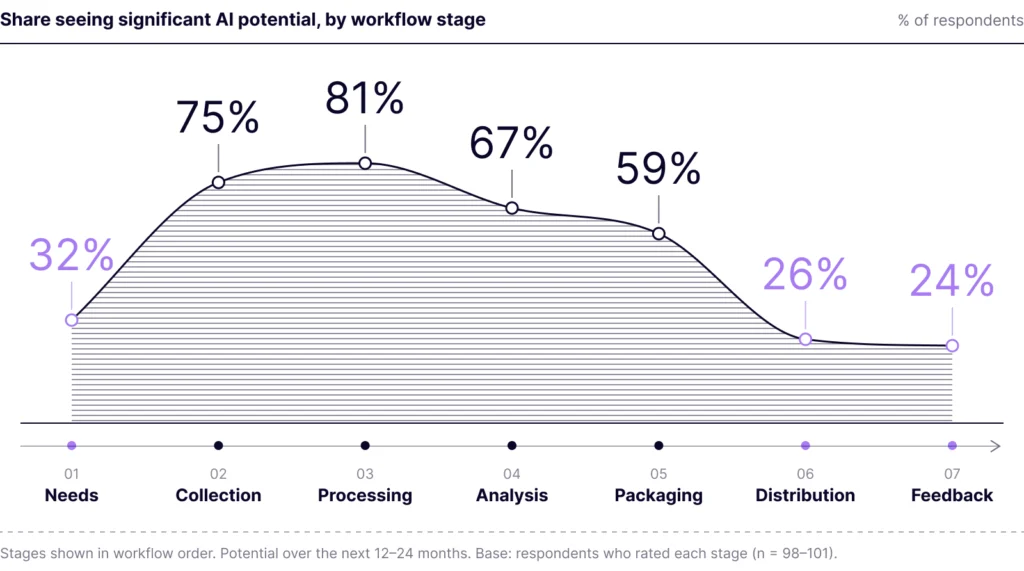
Teams expect AI to go further in the work it already helps with. Collecting, processing and analyzing information are where respondents already describe time savings, and where most expect significant gains still to come.
The stages they rate lowest are the ones built on people: understanding what stakeholders need, getting intelligence to them at the right moment, and finding out whether it made a difference. Most respondents see significant AI potential in processing (81%), collection (75%) and analysis (67%) over the next 12–24 months. Far fewer see it in understanding stakeholder needs (32%), distribution (26%) or feedback (24%).
As AI takes on more of the information work, intelligence teams have more reason to be the place colleagues turn to for the sources, judgment and context that make an answer reliable enough to act on.
Three questions for intelligence leaders
Three questions worth taking into the next planning cycle:
1. Are we judging the whole analysis, or only its facts?
Evidence, coverage, assumptions, context and the decision it serves all need checking.
2. Where are colleagues producing intelligence without us, and what would make their answers more reliable?
Better sources, clearer expectations and a route to a specialist go further than another layer of review.
3. Do we know what happened to our last piece of work?
What it informed, what was missing, and what the next question should be.
Frequently asked questions
According to Valona Intelligence’s Market & Competitive Intelligence Report 2026: AI Edition, AI is increasing how much intelligence teams produce and how quickly it reaches stakeholders, but gains in relevance and strategic value are less widespread. 77% of practitioners surveyed say AI has increased the volume of intelligence they produce and 70% say it reaches stakeholders sooner, while 52% report better relevance to stakeholder needs and 50% higher perceived strategic value.
Checking AI’s work has become the most common change in how intelligence professionals spend their time. More than half (56%) say more of their time now goes to reviewing and validating AI outputs, compared with 37% who say more goes to managing AI tools and workflows and 36% to strategic and advisory work.
Look beyond individual facts. Valona’s Sense Check sets out six criteria for judging whether AI-enabled analysis is reliable enough to act on: traceable evidence, sufficient coverage, visible assumptions, relevant context, connection to the decision and proportionate review. Valona defined them drawing on this study and two decades of research into how intelligence teams work. They apply to any analysis, whoever produced it.
A fact-check is designed to catch invented facts and sources. But many of the problems respondents described came from how an analysis was put together: what it covered, what it compared, which market it described. Examples include a competitor analysis that left out the main competitors, figures from sources using different methods combined to show market growth, and global reports used to answer a local-market question. Every fact can check out while the overall picture is still wrong.
62% of teams systematically review AI-assisted outputs before they reach stakeholders, but that review only covers work that passes through the team. Colleagues across the business now research markets and competitors with AI tools of their own, and some of that work reaches leadership without the intelligence team seeing it. 78% of respondents believe stakeholders trust intelligence more after human review.
Only 26% of respondents have a clear AI policy covering intelligence work. The study found no clear link between how rigorously teams review AI output and whether they have a policy, so rigorous review seems to come down to the team itself.
Mostly in collecting, processing and analyzing information. Over the next 12–24 months, most respondents see significant AI potential in processing (81%), collection (75%) and analysis (67%). Far fewer see it in the stages built on people: understanding stakeholder needs (32%), distribution (26%) and feedback (24%).
The Market & Competitive Intelligence Report 2026: AI Edition is based on a survey of competitive and market intelligence practitioners, conducted by Valona Intelligence between 17 August and 13 September 2026. 108 responses were received. Five were removed before analysis (one incomplete, one duplicate, three from outside the target audience), leaving 103. Valona also interviewed four senior executives in depth: a senior strategy executive in the industrial sector, an EMEA managing director and a regional managing director at global manufacturing companies, and a senior executive at a manufacturing company. Percentages are based on the respondents who answered each question, so bases vary.
The survey behind Valona Intelligence’s Market & Competitive Intelligence Report 2026: AI Edition included 103 competitive and market intelligence practitioners. 61% lead or manage an intelligence function, 26% are analysts or researchers, 8% contribute from a broader strategy, marketing or sales role and 5% hold other roles. 56% work at organizations with 5,000 or more employees. The largest industry groups are manufacturing and industrial, healthcare and medical devices, food and beverage, and chemicals. 31% use Valona Intelligence, 31% another specialist platform, 39% general-purpose tools without a dedicated platform and 11% no formal tooling (more than one answer possible).
Valona Intelligence used AI at most stages of the Market & Competitive Intelligence Report 2026: AI Edition: tabulating survey data, coding open-text responses, drafting and editing, and checking figures against the raw data. At each stage, a person with the relevant expertise directed the work, reviewed the output and took responsibility for it. Every quotation was checked against the survey export or interview transcript, and every figure can be traced to a specific question and base.
Download the Market & Competitive Intelligence Report 2026: AI Edition
One manufacturer lost at least three months when an AI agent was built on the wrong assumptions. The full report has that story and the other executive interviews, plus recommendations for intelligence and strategy teams: how to adapt the Sense Check for recurring work, when an analysis needs an expert, and how to tell stakeholders when AI was involved.