Valona Named as a Leader in the 2026 Gartner® Magic Quadrant™ for Competitive and Market Intelligence Platforms! 🏆

Read more
Earnings Analysis: Agrochemicals | Q2 2026

Fertilizers and agrochemicals industry: pricing recovers, risk persists

Nitrogen and potash prices strengthened this quarter as supply constraints and Middle East disruption tightened global markets, delivering a pricing-led earnings recovery for commodity fertilizer producers. Elsewhere, softer volumes pushed several companies toward cost programs and portfolio actions to protect margins, while product and R&D investment continued.
Methodology

Every score is built from official earnings materials, aligned to the same reporting period, evaluated against a consistent framework, and reviewed by analysts before publication.


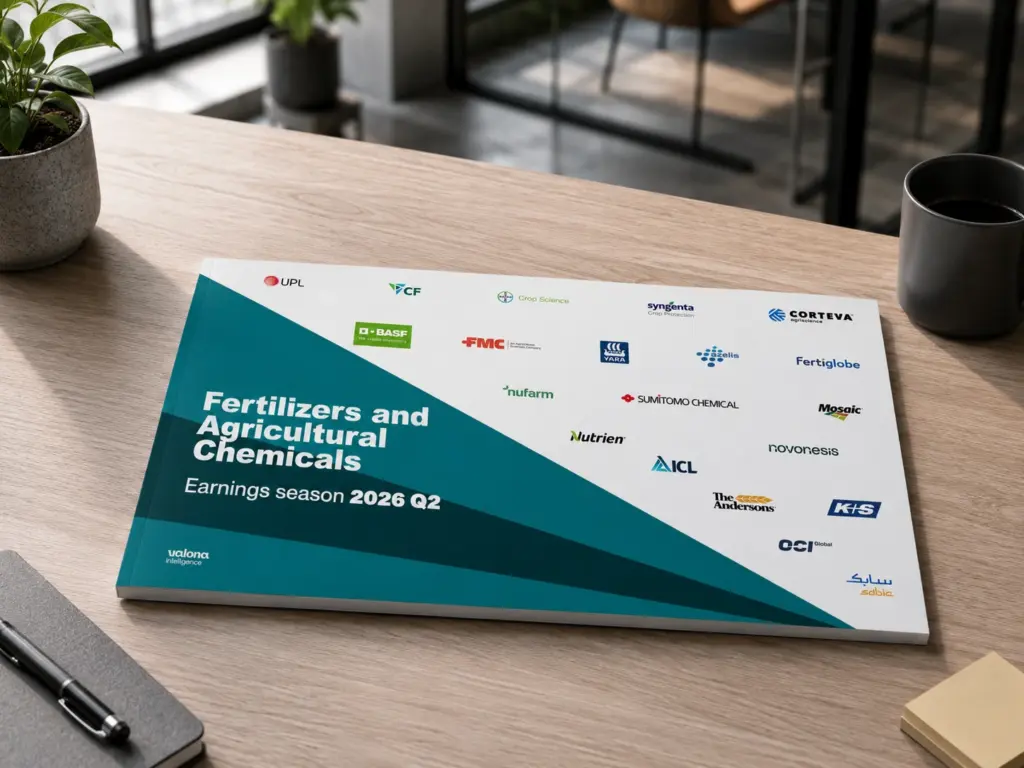
Companies included in this analysis:

Bayer
Syngenta
Corteva
BASF
FMC
UPL
Azelis
Nufarm
Fertiglobe
Sumitomo Chemical
Nutrien
Yara
CF Industries
Mosaic
ICL
The Andersons
K+S
Sabic
Novonesis

What’s changing in fertilizers and agrochemicals industry earnings this quarter

Tight nitrogen and potash fundamentals drove much of the quarter’s earnings strength, and geopolitical disruption sat behind both the opportunity and the risk. CF Industries raised its mid-cycle EBITDA guidance on a nitrogen market it expects to stay tight into 2027, while Fertiglobe’s EBITDA rose 111% year-on-year on higher urea and ammonia prices, even as the same Middle East trade disruption forced it to reroute shipments out of the UAE. Nearly every company named the region as a source of cost pressure or supply-chain rerouting: Sabic and BASF flagged elevated energy costs and disrupted feedstock flows into Europe and Asia, and Yara responded by acquiring Gulf Coast ammonia capacity to cut its reliance on European gas.

Where demand was softer, companies turned to cost programs and portfolio moves rather than volume growth to defend margins. FMC pursued restructuring, an India divestiture, and a licensing deal to reduce debt as net sales fell 17.5%, Corteva’s planned business separation is expected to deliver $115–125m in annual savings by 2027, and ICL launched its “Elevate” program targeting more than $350m in EBITDA savings by 2028.

Even under that cost pressure, investment in new products continued. Syngenta secured almost 900 new registrations and kept building out its AI-powered digital tools for growers, Novonesis launched five new biosolutions while reaffirming 5–7% organic growth guidance, and Bayer advanced hybrid wheat development alongside its cost-control efforts.

Three companies worth a closer look

CF Industries: Net sales rose 17.6% to €1,970M and EBITDA margin expanded to 52.5%, up 12.4 points, as tight global nitrogen supply and strong North American agricultural demand supported pricing. The company advanced its Blue Point project and raised its mid-cycle earnings outlook on structurally tighter nitrogen markets.

Yara: Net sales grew 8.1% to €3,777M as stronger ammonia pricing and cost discipline offset higher energy costs and lower delivery volumes. Yara completed its Gulf Coast Ammonia acquisition to diversify its energy exposure and outlined further efficiency targets through the end of the decade.

ICL: Net sales rose 16.5% to €1,892M on higher potash, bromine, and phosphate prices, with cost-saving initiatives helping offset elevated raw material costs. ICL launched a multi-year cost transformation program and a new organizational structure aimed at its core growth areas.

Competitor intelligence at earnings speed

This summary covers Q2 2026 across a selection of companies in the fertilizers and agricultural chemicals industry. Each summary brings together what a full earnings season would otherwise take days to piece together:

  • A synthesis of the cross-company themes shaping the quarter
  • Sentiment scoring across five dimensions: revenue development, profit development, market conditions, revenue outlook, and profit outlook
  • Company-by-company breakdowns of results and drivers
  • Forward-looking signals and guidance from management

The Valona platform extends the same structured analysis to each company individually, updated as new earnings and disclosures are published.

Earnings analysis is only useful when it’s consistent, evidence-based, and comparable across companies and quarters. Applying the same framework every time turns a quarter’s worth of transcripts and disclosures into a dependable input for competitive intelligence, rather than commentary that depends on memory or individual interpretation Learn more about earnings analysis.

Never miss an industry earnings season

Sign up for Valona’s Insights and we’ll send you the next fertilizers and agricultural chemicals industry earnings summary along with exciting product updates, information on upcoming events, industry news, and other helpful resources.