Data Center Power Demand: Where the Electrical Equipment Orders Are Going
Data center power demand is outpacing grids and equipment makers. See where electrical equipment orders are going and the decisions electrical equipment makers face now.
Data center power demand is growing faster than grids and equipment makers can deliver. Global demand is heading for 84 GW by 2027 [1], yet US transformer lead times run 128 to 144 weeks and grid connections can take seven years. When demand outstrips supply, buyers favour vendors who can scale capacity rapidly.
Announced is not built. Of about 16 GW of data center capacity planned worldwide for 2026, only about 5 GW was under construction in February 2026 [2]. Money is not the brake: Alphabet, Amazon, Microsoft and Meta plan around USD 700bn of capex in 2026 [3]. The brake is the electrical chain of grid connections, transformers, switchgear and cable.
This brief looks at that chain from the equipment makers’ side: where demand is landing, why supply can’t keep up, who is taking the orders, and the decisions electrical equipment strategy teams face now.
In this article
- How much power does a data center use?
- Data center power is held back by the electrical chain, not money
- Who is winning data center equipment orders?
- What electrical engineering companies say about data center power demand
- Four decisions data center power forces on electrical equipment makers
- What to monitor to know when data center equipment supply eases
- What this means for electrical equipment strategy
- FAQs
How much power does a data center use?
A conventional data center draws 10 to 25 MW. A hyperscale AI site draws 100 MW or more, as much electricity in a year as 100,000 households [4]. At the top end, AI training campuses now need 1 GW or more on a single site.
- xAI’s Colossus 2 in Memphis became the first 1 GW training cluster when it went live on 17 January 2026 [5].
- Microsoft is building its Mount Pleasant campus in Wisconsin toward 3.3 GW by late 2027 [6].
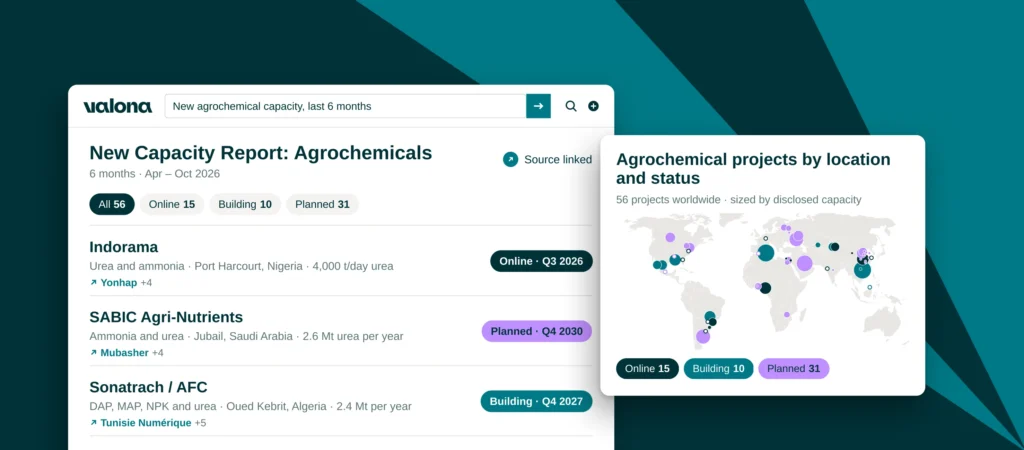
- At least 20 of the 56 projects in Valona’s New Capacity Report for data centers are 1 GW or more [7]. Many others don’t disclose their capacity.
- The average announced project was worth USD 460m in 2022. By 2025 it was USD 1.9bn [8].
For equipment makers, the jump in size changes the order itself. A 1 GW campus needs a high-voltage substation, several large power transformers and a dedicated grid connection, often specified years before delivery, by the utility, the developer or both. Fewer, bigger high-voltage orders put more weight on each tender, and on being in the room early enough to win it.
How fast is data center power demand growing?
Goldman Sachs Research expects global data center power demand to reach 84 GW by 2027, up from about 55 GW in early 2025 [1].
- Disclosed US data center capacity alone reached 331 GW by Q1 2026, with about 40% of it under active development [9].
- North American construction hit a record 7,481 MW in H1 2026. Over 80% was leased before completion, and vacancy fell to a record low of 1.4% [10].
- Worldwide, about 2,500 GW of advanced-stage renewable, storage and large-load projects are waiting for a grid connection [11].
The two signals fit together. Record preleasing and 1.4% vacancy in North America’s primary markets show that capacity which actually gets built is snapped up. The pipeline shows how much never gets that far: Goldman Sachs assumes only a quarter to a half of Europe’s pipeline will be built, and in the US, most capacity planned for 2026 and 2027 had not broken ground by mid-2026. For equipment makers, the useful number isn’t the size of the pipeline. It’s how much of it secures a grid connection and moves into construction.
How much data center capacity is Europe adding?
Europe’s data center market is on track to reach 13 GW by the end of 2026, up 20% on the year [10]. More of that growth is now landing outside the traditional hubs.
- Europe added nearly 700 MW in Q2 2026, and 63% of it went outside the main hub markets [10].
- The largest projects show where it’s going: Google is investing EUR 13bn in Finland, Schwarz Digits EUR 11bn in a campus in Lübbenau, Start Campus is building a 1.2 GW site in Sines and Prime a 550 MW campus in Esbjerg [12].
- Great Britain’s electricity demand queue grew from 41 GW to 125 GW by June 2025. Data centers account for 73 GW of it [13].
The pipeline behind those numbers is far larger than what will get built. Goldman Sachs Research put Europe’s data center pipeline at around 170 GW, based on grid connection requests. That’s about a third of Europe’s 2024 peak power demand, and Goldman assumed only 25 to 50% would be built [1]. In the European countries that publish queue data, almost 700 GW of renewable and large-load projects were waiting for a connection in April 2026 [14]. Italy’s grid operator Terna alone had requests for nearly 600 data center projects, totaling more than 100 GW, by October 2026. In May 2025 the figure was 42 GW [15].
For equipment makers, where the capacity lands matters as much as how much there is. Large campuses need new high-voltage capacity wherever they are built. In the traditional hubs that means waiting in the longest queues. Outside them, developers often pick sites with existing infrastructure, such as Start Campus in Sines, built next to a closed coal plant, and then expand the grid connection: Sines’ was doubled to 1.2 GW. Either way, more of the high-voltage work is moving to regions where suppliers may not yet have the service teams or utility relationships to win it.
Data center power is held back by the electrical chain, not money
Data center capacity is being announced faster than it can be connected. The bottleneck is grid access and electrical equipment, not money.
- In February 2026, only about 5 GW of the roughly 16 GW planned worldwide for 2026 was under construction [2].
- Currence expects 30 to 50% of the 2026 pipeline to slip into a later year [16].
- The outlook for 2027 is similar. In June 2026, more than 60% of the capacity planned for that year had not broken ground, and another 7% was already delayed [17].
- Even the largest programs are slipping: Oracle has moved several Stargate centers from 2027 to 2028 [18].
For equipment makers, delayed projects often push orders back rather than cancel them. A campus that slips a year still needs its transformers and switchgear, just later, and often on a tighter schedule once its grid connection comes through. Cancellations happen too, with eight US projects aborted in Q2 2025 alone [10], but a cancelled site’s grid connection is often taken over by someone else, as Microsoft did with OpenAI’s Narvik site in Norway. The risk is in planning output around announced completion dates. In June 2026, more than 60% of the capacity planned for 2027 had not broken ground [17]. Customers whose projects slip ask to take deliveries later, and factory slots planned for 2027 may not be needed until 2028. While the market is tight, those slots are easy to resell. When it turns, they won’t be.
How long does it take to get power to a new data center?
A new grid connection can take up to seven years, longer than it takes to build most data centers. Figure 1 below compares how long each route to power takes at the upper end.
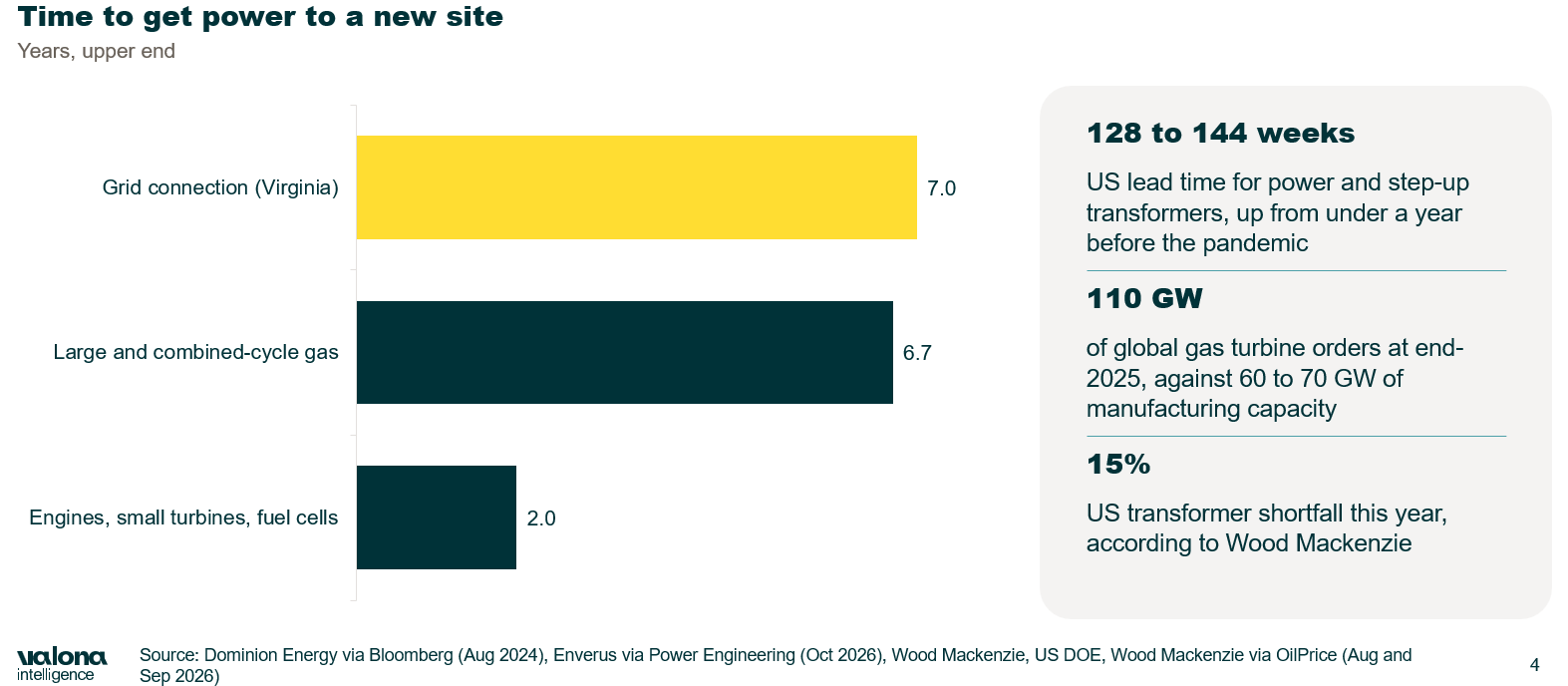
- Grid connection, 7 years (yellow bar). In Virginia, the US’s largest data center market, Dominion Energy quotes waits of up to seven years for a new connection [19].
- Large and combined-cycle gas, 6.7 years. Building your own power plant at scale is barely faster: up to 80 months [20].
- Engines, small turbines and fuel cells, 2 years. These are the only quick option, at 18 to 24 months, but they cover a fraction of a large campus’s load [20].
The panel beside the chart shows why the wait is so long. US lead times for power and step-up transformers have reached 128 to 144 weeks, against under a year before the pandemic [9][21]. Wood Mackenzie expects a 15% US transformer shortfall this year [9]. Gas turbines are just as stretched, with 110 GW of global orders at the end of 2025 against 60 to 70 GW of manufacturing capacity [9].
That gap makes the grid connection the critical path for many new campuses. Construction finishes, but the site can’t run at full load until its connection is energized. For equipment makers, the transformers and switchgear on both sides of that connection, at the utility and on the campus, are among the main items deciding when a data center actually opens. Some developers bridge the wait with small on-site units. Those need their own switchgear and transformers, mostly at medium voltage, and the grid-side equipment is still needed once the connection comes through. Bridging adds demand rather than just bringing it forward.
How long are transformer and switchgear lead times?
In the US, large power transformers now take 128 weeks to deliver and generator step-up transformers 144 weeks. Before the pandemic, both took under a year [9][21].
- High-voltage circuit breakers take about 125 weeks, and some medium-voltage switchgear more than a year [22].
- Wood Mackenzie expects US transformer supply to fall 15% short of demand in 2026 [9].
- The US makes only about a fifth of the large power transformers it buys [21].
- Electrical steel, the core material, is scarce in the US and oversupplied in the EU. thyssenkrupp has idled plants, and the EU introduced safeguards in September 2026 [23][24].
Europe is not much better off. In Europe and North America, transformer and high-voltage circuit breaker lead times have reached two to three years, about twice the 2019 level. Units above 20 MVA take more than 12 months, units above 100 MVA more than 24, and some large power transformers three to six years [48]. Rystad sees the growth in lead times and prices leveling off, with peak lead times possibly easing within a year. It also sees Europe turning from a net exporter of power transformers into a net importer [48]: non-European suppliers already make up 42% of Europe’s power transformer imports [25].
Gas turbines show the same gap. Global orders reached 110 GW at the end of 2025, against 60 to 70 GW of manufacturing capacity [9]. Q2 2026 brought a record 38 GW of orders, up 71% on the year [17], and GE Vernova is already selling delivery slots for 2031 [26].
For European equipment makers, the two markets pull in different directions. The US makes only about a fifth of the large transformers it buys, which keeps export demand strong for now, but most new capacity is being built inside the US, by European and Asian makers among others. At home, Europe has the steel but is losing ground to imports. Lead times that have stopped rising are the first sign of relief, but they are still twice their 2019 level. For planning, the real question is how fast recently announced capacity reaches first output, and on which side of the Atlantic.
Are grid queues a problem in Europe too?
European grid connection waits match or exceed those in the US, and some countries have stopped accepting new requests altogether.
- In Germany, a grid connection can take up to 13 years [27].
- Denmark’s grid operator Energinet paused new large connection agreements in 2026. It had received requests for 60 GW, against a national peak load of about 7 GW [28].
- Local opposition is a second brake. In Frankfurt, EdgeConneX shelved an off-grid gas plant after protests.
The US is seeing the same pushback. Texas paused new data center grid approvals in August 2026, with more than 1,800 projects and 474 GW waiting in the ERCOT queue [29]. About 7 in 10 Americans oppose a data center in their area [30].
For equipment makers, the queues and the shortages tell different stories, and both are true. Announced data center capacity overstates the orders coming in the next two years, because much of it is stuck in a queue or will never be built. Lead times show that the equipment shortage is real all the same. Planning on either signal alone gives the wrong answer. What matters is which projects actually get a connection date, and where.
Who is winning data center equipment orders?
The orders are going to equipment makers that add capacity close to demand, and to outsiders entering the market, while buyers increasingly fund supply themselves. According to Wood Mackenzie, data centers could take as much as 40% of US power-equipment supply in the next few years [9].
Earnings show how unevenly those orders land. At Schneider Electric, data center orders grew by triple digits in Q3 2026 and now make up around 30% of all orders [31]. ABB reported triple-digit growth in data center orders in Q1 2026, with Electrification orders up 44% [32]. Hitachi Energy’s order growth comes mainly from large HVDC projects, and data centers are still a smaller share [33]. Supply is moving too: Rystad Energy expects nearly 200 GVA of new transformer manufacturing capacity to come online in 2026, led by the US [25].
Table 1 sets out eight ways the market is responding, with examples of each and what they mean for electrical equipment makers.
| Move | Examples | What it means for electrical equipment makers |
|---|---|---|
| Incumbents build next to demand | In Mississippi, Amazon is committing USD 25bn and xAI over USD 20bn to data centers. Hitachi Energy is building a USD 528m transformer plant in Gallman, with output from 2029. Siemens Energy broke ground on a USD 300m high-voltage switchgear plant in Pearl in July 2026 [6][34][35][36]. | Distance to the load cluster is becoming a siting criterion for new factories. |
| Europe adds grid supply chain capacity | Sumitomo opened the UK’s first HVDC cable plant in October 2026, a GBP 350m investment in 525 kV subsea cable. | European capacity is going into transmission links as well as substations. |
| Asian makers build in the US | HD Hyundai and Hyosung are expanding US plants for 765 kV transformers. | Local content is becoming part of the offer, and European makers face more competitors in the US. |
| Outsiders and contract manufacturers enter | Jabil runs a new USD 30m Siemens medium-voltage switchgear plant in Virginia from fall 2026. Sanmina and Končar open a plant in Houston in 2027. Solar-tracker maker GameChange is building a transformer factory in Mumbai for units up to 500 kV, 150 a year from Q1 2028 [35][37]. | New capacity is arriving from companies that were not on the competitor list two years ago. |
| Incumbents buy regional makers | GE Vernova paid USD 5.3bn for Prolec GE. ABB bought Specialtrasfo, and Hitachi Energy is buying insulation maker Canduct. Schneider Electric offered about EUR 1.2bn for smart-building specialist Shelly in September 2026. | Acquisition targets and partners are being taken, and the companies you meet in tenders are changing. |
| Buyers fund or reserve capacity | Equinix is putting up to USD 700m into Hanley Energy’s new plant in Ireland [38]. Enedis signed EUR 350m frameworks with Hitachi Energy. UK switchgear capacity is going to data center frameworks [39]. | Factory output is being sold before it exists, and contract terms are being set now. |
| Developers become power producers | Meta is funding seven new gas plants with 5.2 GW in Louisiana under a deal with Entergy [40]. The Ohio campus OpenAI leases is planned with 9.2 GW of gas generation [41]. | Data center developers increasingly shape what gets ordered, even when a utility builds and owns the plant. |
| Substitutes route around the shortage | Siemens and Reinhausen are developing a solid-state transformer that converts up to 36 kV straight into 800 V DC, with no timeline yet [42]. JPMorgan expects aluminum to replace about 2% of copper demand in 2026 and 6% by 2030 [17]. Prysmian supplies low-carbon aluminum cables for an Amazon data center in Ohio [6]. | Today’s product can be designed out of the next data center spec. |
Figure 2 picks out six of these moves at a glance. The most telling is in the top left: in Mississippi, data center demand and new equipment supply are landing in the same state.
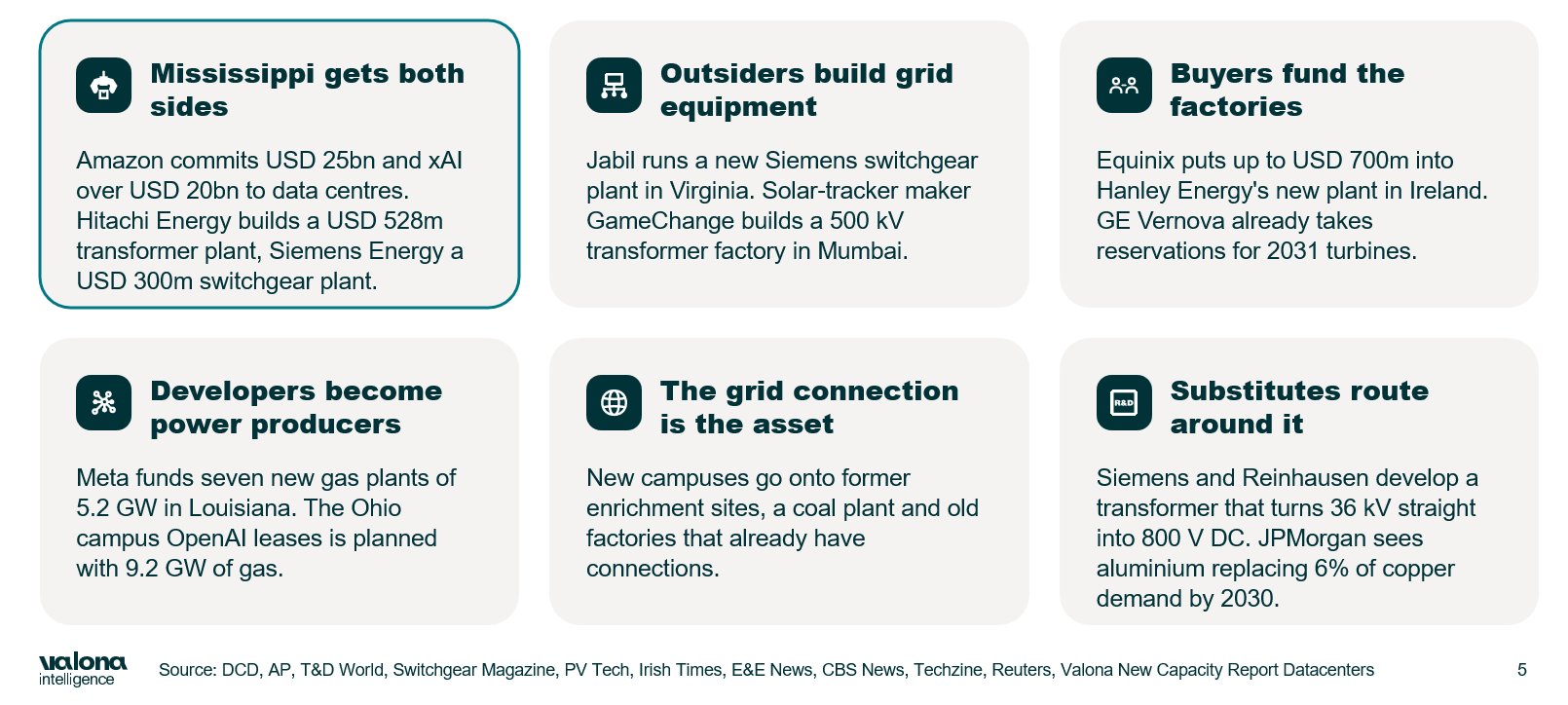
The grid connection itself has become the most valuable part of a data center site, as the “grid connection is the asset” card in Figure 2 shows. New campuses are going onto former uranium-enrichment sites in Ohio and Kentucky, the Homer City coal plant, and old Electrolux, Delphi and Foxconn factories, because those sites already have connections [7]. Construction fell 14% in Northern Virginia and 29% in Silicon Valley, while Chicago grew 169% [10].
What electrical engineering companies say about data center power demand
Table 1 shows where the orders are going. Quarterly earnings show whether those orders are turning into revenue and margin. Every quarter, Valona analyzes earnings across multiple industries, tracking what executives say about performance, outlook and markets alongside their reported financials. That shows shifts in industry sentiment as they happen.
For electrical engineering, the Q3 2026 season saw revenue grow across the group, and companies with the most data center exposure pulled furthest ahead.
- Schneider Electric posted record Q3 revenue of €11.5bn, up 17% organically, and its data center orders grew at a triple-digit rate [31].
- ABB’s revenue grew 14% while orders rose 40% to a record $12.1bn, and its data center orders more than doubled. North America led, while Europe grew more slowly [49].
Pricing broadly kept pace with costs: ABB’s margin rose 1.6 points as price increases and efficiency more than offset commodity and freight inflation [49], and Schneider expects pricing to offset raw material inflation and net tariffs this year [31]. Most raised their full-year guidance, Schneider among them, lifting its organic revenue growth outlook to 12–14% [31].
The main risk is concentration. Much of this growth now depends on AI data center spending holding its current pace.
Companies are investing to capture the demand. Some are buying their way into high-voltage equipment, while others are adding factory capacity.
- GE Vernova’s Electrification equipment backlog reached $42bn, up 60% year on year on strong grid demand, partly from consolidating Prolec GE. The company also agreed to buy Trench for $9bn to expand in high-voltage grid equipment [50].
- Siemens Energy plans to raise its capacity for large power transformers and switchgear by 50% between 2026 and 2030 [51].
- HD Hyundai Electric completes its Ulsan transformer expansion in Q4 2026. Together with a second plant in Alabama from H1 2027, it raises transformer production capacity by 50% [52].
All of this capacity is being committed now, into a market whose peak nobody can yet date. That leaves electrical equipment makers with four decisions to make before the shortage resolves.
Four decisions data center power forces on electrical equipment makers
New capacity announced today won’t reach the market until 2028 or later. Equipment makers have to commit before anyone knows when the shortage ends. GameChange’s transformer plant starts output in 2028, Hitachi Energy’s in 2029, and GE Vernova is already selling turbine slots for 2031.
Analysts can’t agree on the timing. UBS expects the US and European transformer gap to narrow sharply in 2027 [43]. Citi expects the shortage to last until at least 2029 [44].
That uncertainty feeds into four strategic decisions. Table 2 sets out what each one depends on and what a wrong call costs.
| Decision | What it turns on | What a wrong call costs |
|---|---|---|
| Where and when to add capacity | Rivals’ new plants and when they reach first output | Capacity arrives as the market turns, and is tied up for a long asset cycle. |
| Build, buy or partner | Incumbents buying regional makers, and contract manufacturers running plants for incumbents | Your supplier or acquisition target ends up owned by a competitor. |
| Which designs and segments to back | Solid-state transformers, SF6-free switchgear, 800 V DC and aluminum in place of copper | Your product is designed out of the next data center spec. |
| How to sell or secure capacity | Frameworks, reservation contracts and buyer-funded plants | Pricing power given away, or a factory slot lost. |
The first row of Table 2 has a real-world example. In 2019, Mitsubishi Electric Power Products sold its Memphis transformer plant to Hyosung for USD 46.5m and stopped making large power transformers in the US [20]. Hyosung has since put about USD 300m into the plant [45] and expects its US transformer market share to rise from 6% to more than 10% [46].
Getting it wrong in the other direction is just as costly. After the 2006 to 2008 transformer boom, overcapacity and eroded margins reshaped the industry for years [23]. With new US high-voltage transformer capacity costing about USD 450 to 500m per GVA [44], a mistimed plant is an expensive mistake.
All four decisions come down to timing: when rivals’ plants reach first output, when buyers lock up supply, and when new designs enter the spec. Getting that right means tracking them continuously, not reading one forecast.
What to monitor to know when data center equipment supply eases
Five signals show whether the electrical equipment shortage is easing or getting worse. Tracked together over time, they show whether UBS’s 2027 view or Citi’s 2029 view holds for your segments.
- Lead times and prices: transformers, breakers, switchgear and cable. Falling lead times are usually the first sign that new capacity has reached the market.
- New factories: from announcement to first output. A plant adds nothing until it ships, and many announced plants slip.
- Capacity deals: frameworks, reservation fees and buyer-funded plants. These show how much future output is already spoken for.
- M&A and newcomers: who buys whom, and who enters from outside the industry. Together they decide who you’ll face in the next tender.
- Grid rules: queue reforms, pauses and flexible connection terms. TenneT freed over 9 GW with time-based grid rights, and Spain’s CNMC has allowed connections without firm capacity since 1 September 2026. Rules like these decide where demand can land, and how fast.
No single signal settles it. Lead times can fall while capacity deals quietly lock up the next three years of output, and a wave of new factories means little if half of them slip. The shortage is easing when lead times fall, new plants reach first output on schedule and less future output is pre-sold, all at once.
What this means for electrical equipment strategy
Data center power has given electrical equipment makers record order books. The hard part is timing: deciding where to add capacity, and when, before anyone knows how long the shortage lasts. Data centers are also only part of the pull. Grid upgrades, renewables and industrial electrification are competing for the same transformer and switchgear factories.
The big question is when new transformer capacity will actually reach the market. For all the announced investment, European lead times are still two to three years. GameChange’s new plant starts output in 2028 and Hitachi Energy’s in 2029. UBS expects the gap to narrow in 2027, while Citi expects the shortage to last until at least 2029. Which forecast holds will decide which capacity bets pay off.
Track electrical equipment market and competitive intelligence with Valona
The patterns in this brief didn’t come from a single source. They became visible by connecting data center projects, factory announcements, lead times and capacity deals across regions and over time.
Valona brings those signals together into continuous, validated competitive and market intelligence. That helps strategy, innovation and market intelligence teams understand what’s happening in heavy industry, what it means, and what to do next. For data center power, that means following data center projects and new transformer plants from announcement to first output.
Curious what this looks like in your own segments? See how Valona helps heavy industry manufacturers spot shifts like these early.
FAQs
A conventional data center draws around 10 to 25 MW, and a hyperscale AI-focused data center 100 MW or more, as much electricity a year as 100,000 households [4]. The largest AI training campuses now need 1 GW or more: xAI’s Colossus 2 in Memphis became the first 1 GW training cluster in January 2026, and Microsoft’s Mount Pleasant campus targets 3.3 GW by late 2027. Globally, data center power demand is forecast to reach 84 GW by 2027, up from about 55 GW in early 2025 [1].
Demand for power transformers is rising faster than factories can expand. Data centers, grid upgrades and renewables all need the same equipment. In the US, large power transformers take about 128 weeks to deliver, against under a year before the pandemic [9][21]. In Europe, lead times for transformers and high-voltage breakers are at least two to three years [25]. Wood Mackenzie expects a 15% US transformer supply shortfall in 2026, and new factories announced now mostly start output in 2028 or 2029.
Grid operators are receiving far more connection requests than their networks can serve. About 2,500 GW of advanced-stage projects are waiting for a grid connection worldwide [11]. In Virginia, connections can take up to seven years, and in Germany waits can reach 13 years. Denmark paused new large connections in spring 2026 after receiving 60 GW of requests against a peak load of about 7 GW.
Incumbents, Asian makers and outsiders are all adding capacity. Hitachi Energy is building a USD 528m transformer plant in Mississippi, and Siemens Energy a USD 300m switchgear plant in the same state. HD Hyundai and Hyosung are expanding US transformer plants. Contract manufacturer Jabil runs a Siemens switchgear plant in Virginia, and solar-tracker maker GameChange is building a transformer factory in Mumbai. Buyers such as Equinix are funding plants directly.
Analysts disagree on when the transformer shortage ends. UBS sees the US and European gap narrowing sharply in 2027, while Citi expects the shortage to last until at least 2029. The answer depends on how many announced factories actually reach first output on time, how much capacity buyers have already reserved, and whether data center projects keep slipping. Tracking those signals segment by segment gives a clearer view than any single forecast.
Sources
[1] Goldman Sachs Research, Feb 2025
[2] Sightline Climate via Latitude Media, Feb 2026
[3] Yahoo Finance
[4] IEA, Energy and AI, Apr 2025
[5] Interesting Engineering, Jan 2026
[6] DCD (Data Center Dynamics)
[7] Valona Intelligence, New Capacity Report for data centers, Oct 2026
[8] GlobalData via Power Technology
[9] Wood Mackenzie, Q2 2025 survey and 2026 analysis (via APPA and OilPrice)
[10] CBRE, via DCD, Aug 2026, and Data Center Frontier, Sep 2026
[11] IRENA via Anadolu Agency, Sep 2026
[12] Talouselämä; Berliner Zeitung; W.Media
[13] Energy Institute
[14] Ember, Apr 2026
[15] Terna, Oct 2026
[16] Currence via Network World, Jul 2026
[17] JPMorgan research, via WSJ, OilPrice and Finimize, 2026
[18] TechRadar
[19] Dominion Energy via Bloomberg, Aug 2024
[20] Power Engineering, Dec 2019; Enverus data via Power Engineering, Oct 2026
[21] US Department of Energy
[22] Manufacturing.net, Sep 2026
[23] Transformer Magazine, 2026
[24] WDR, Sep 2026
[25] Rystad Energy, Grid Equipment Market Outlook, May 2026
[26] Utility Dive
[27] Merkur, Oct 2026
[28] Energinet, 2026
[29] NBC DFW, Aug 2026
[30] Gallup via Fortune
[31] Schneider Electric, Q3 2026 results, Oct 2026
[32] ABB, Q1 2026 results, Apr 2026
[33] Hitachi Energy, 2026 results
[34] AP
[35] T&D World
[36] Switchgear Magazine, Jul 2026
[37] PV Tech
[38] Irish Times
[39] IT Brief UK, Feb 2026
[40] E&E News, Mar 2026
[41] CBS News, Mar 2026
[42] Techzine
[43] UBS via 10jqka, Sep 2026
[44] Citi via Longbridge, Mar 2026
[45] Korea JoongAng Daily
[46] KED Global, Mar 2025
[47] Reuters
[48] Rystad Energy via Power Peak Digest, Jun 2026
[49] ABB, Q3 2026 results, Oct 2026
[50] GE Vernova, Q3 2026 results, Oct 2026
[51] Siemens Energy, Q3 FY26 pre-close call transcript, 29 June 2026
[52] HD Hyundai Electric, Q3 2026 results