What Q2 2026 QSR Earnings Tell Food Processors and Fast-Food Procurement Leaders
QSR chains are rethinking value as traffic, pricing and store economics reshape growth. Here are our Q2 2026 findings on what changing QSR strategies mean for food processors and fast-food suppliers.
Most quick-service restaurants chains grew system sales in Q2 2026, but that number doesn’t tell the entire story.
If we go to one level deeper, we see that there is a clear split on how those comparable sales numbers are built up. Some chains grew transactions and let average ticket fall. Others held the comparable sales up with price while traffic softened. Both produce a positive number for this quarter, but only one will carry it into the next.
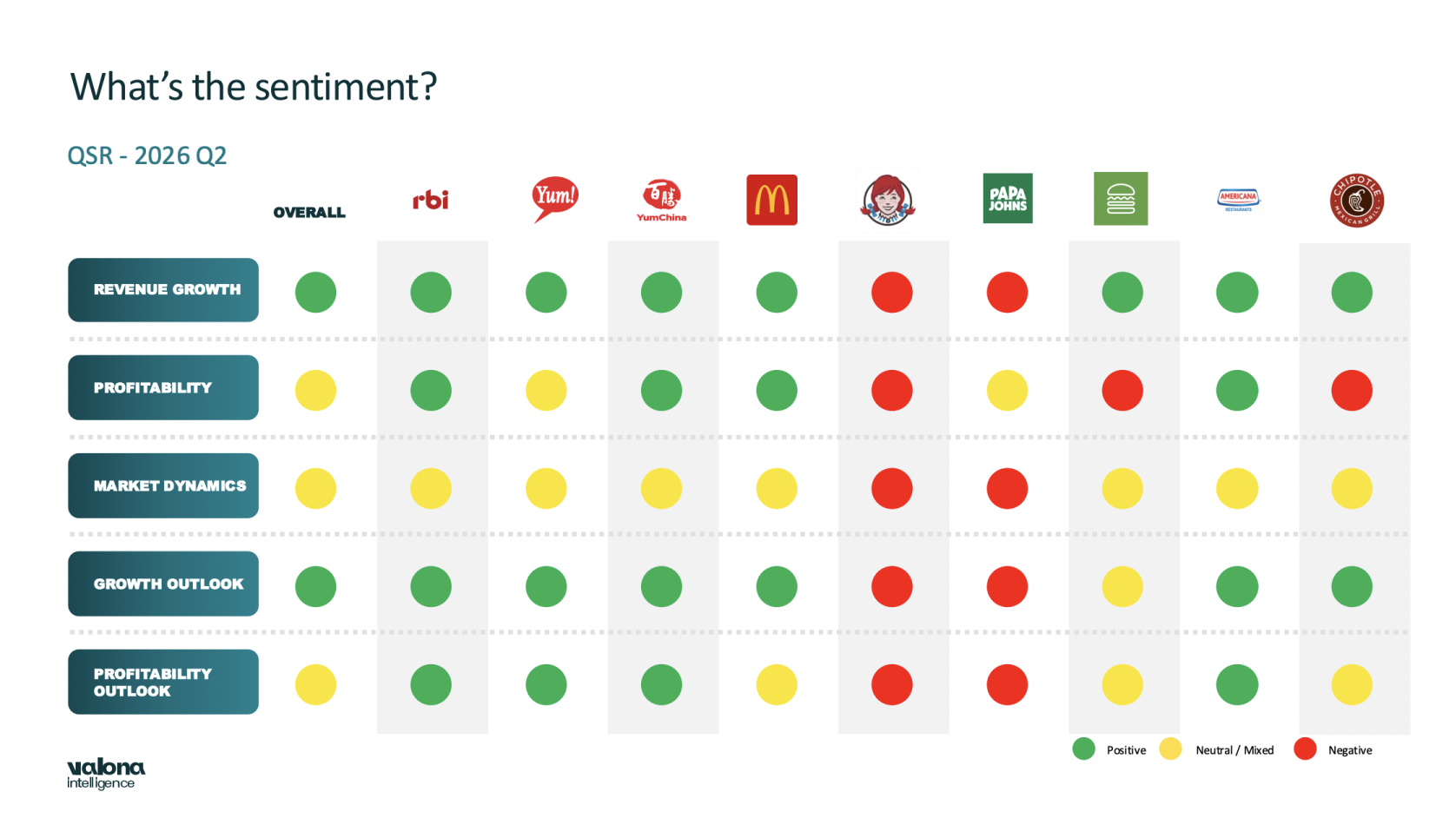
Yum China is the clearest case of the first. Pizza Hut China grew same-store transactions 13%, its fourteenth consecutive quarter of transaction growth, against an 11% decline in ticket size. CFO Adrian Ding described the ticket fall as the plan rather than the cost, moving average spend toward a mass-market target range.
Wendy’s is the clearest case of the second. Global same-restaurant sales fell 6.3%. Underneath sat a 12.5% collapse in traffic, partly offset by a 5.6% higher average check. CFO Steve Cirulis was blunt about which number management watches: “The traffic trend is the one that we pay the most attention to.”
Value stopped being a menu tier. Chains winning took price out.
Wendy’s new CEO Bob Wright described the shift from the losing side of it.
“Traditionally in the QSR space, you would think of value as that bottom right-hand side of the menu board, where it may even have the title Value Menu. That’s where value was compartmentalized. Today’s consumers are looking for value everywhere.”
His diagnosis of the cause deserves attention from anyone supplying a chain under pressure: “in some areas, we’ve let cost and efficiency drive decisions that weaken that differentiation.” That is a chief executive saying past procurement choices damaged the brand.
The operators gaining share are pulling price out rather than pushing it in. Greggs held its £3.25 breakfast meal deal and cancelled a planned autumn price increase, framing it as protecting a long-term position rather than reacting to elasticity. Sapphire Foods and Devyani International restored KFC India margins by cutting discounting and moving marketing spend from delivery promotions to dine-in visits, which lifted transactions rather than suppressing them.
McDonald’s shows how hard this is across a franchised system. Chris Kempczinski disclosed that only 60 to 65% of the US system runs the recommended pricing architecture of ten items under $3. The platform exists. The system is not running it.
These dynamics force food processors further into their role as partner rather than just a supplier: a chain rebuilding value through the core menu rather than a discount tier will want to revisit specifications, portion sizes and price architecture together. Cost-down alone stops being the winning pitch.
Store economics now sets the opening rate
Another clear emerging trend is a changing perspective of how unit growth needs to support long-term system sales growth. Most majors still grew system sales faster than comps, and Yum! grew unit count 5% against 3% worldwide same-store sales. What changed is how central new openings are to longer-term strategy, and what is driving the view on that.
McDonald’s pushed its 50,000-restaurant target from 2027 to 2028, naming the cause precisely: “the current pressured consumer environment, coupled with the cumulative inflationary impact on development costs.” Domino’s trimmed its US net store target because a weak start to the year hit franchisee profitability and slowed the pipeline. Wendy’s closed a net 71 restaurants in the quarter.
Yum China ran the identical logic in reverse. Buying the Pizza Hut brand in Mainland China removed a licence fee worth 2.8 points of restaurant margin, and CEO Joey Wat drew the conclusion immediately: “This will enable more potential new stores to meet our payback requirement of two to three years. We now expect net new openings to exceed 800 per year, up from our original target of over 600.”
Unit economics now matter more than ever, which, is why the gap between brands has widened so far. Burger King US comps ran +8.5% and Taco Bell +7%, while Wendy’s US sat at -7.0% and Wingstop domestic at -7.5%.
Aggregated by category a pattern appears, with chicken outperforming burger chains. Yum!’s KFC grew system sales 9.7% with margin up 1.6 points, and Americana’s KFC business in the Gulf grew like-for-like 12.6%. For Wingstop this growth sits outside of the domestic market: a 102 net openings drove a global systemwide sales growth of 5.3%.
Emerging markets still clear the payback hurdle and remain the route to future growth
Growth keeps concentrating outside mature Western markets, and the reason is store-level returns rather than sentiment.
Yum!’s CFO Ranjith Roy sized it: “KFC’s restaurant density in those markets is only 1/5 that of its top 25 markets, representing a 20,000 unit opportunity,” naming India, Southeast Asia, West Africa and Brazil. The Middle East passed 1,500 KFC restaurants this quarter on paybacks of two and a half to three years. Yum China opened 560 net new stores, a second-quarter record and 67% above last year, with chain penetration in China having moved “from 20% to 30%+. It’s still relatively low compared with 60%+ in mature market.” India told the same story from a lower base, with Devyani International growing revenue 16.7% and Westlife Foodworld posting 4.3% same-store sales growth on double-digit guest count increases.
Emerging-market unit growth remains a key lever for future growth, but it is increasingly served by local processing capacity. More frequent supply chain shocks see chains seeking out supply routes that are less prone to disruption, forcing food processors to adjust their production footprints accordingly.

Portfolio restructuring is putting suppliers in front of new counterparties
The structural move of the quarter was chains choosing to compete in fewer categories so they can defend the ones they keep.
Yum! completed the sale of Pizza Hut for $2.7bn in two legs, the Mainland China business to Yum China on 7 August and the rest to LongRange Capital on 1 September. Ranjith Roy quantified what was shed: “Pizza Hut comprised about 10%-12% of our operating profit. You can imagine, it took a lot of time, resources, and focus to manage it.”
Wendy’s is the same decision from the other direction: guidance withdrawn, dividend halved, 289 US restaurants closed in the first half, and a full turnaround plan deferred to November. Devyani International and Sapphire Foods are merging into a single Yum! franchisee for India, targeting ₹210 to 225 crore of annual synergies the companies attribute directly to centralized procurement and improved vendor bargaining power.
These portfolio moves see food processors deal with new counterparties that are looking to recapture value in part by closing a better deal. It also sees food processors deal with new counterparties that are more focused on the category, providing opportunities for joint menu innovation and development.

The demand shift that will matter most went unmentioned on every call
Across twenty chains, exactly one company mentioned GLP-1 medications. Not McDonald’s. Not Wendy’s. Not Chipotle. No sell-side analyst raised it on any call either.
The exception is Krispy Kreme. CEO Josh Charlesworth reported research finding that “Krispy Kreme consumers who use these medications are just as likely as non-users to purchase sweet treats for holidays and special occasions,” then described a response built on Minis, Doughnut Dots and Mini Crullers. Smaller formats, sold on value and variety rather than health.
The outside evidence has moved past simple demand destruction. Cornell-led research in the Journal of Marketing Research found an 8.0% decline in limited-service restaurant spending within six months of adoption, and Bain puts the fast-food effect nearer 5%. Against that, the National Restaurant Association found in May 2026 that GLP-1 users average 7.6 restaurant visits a week versus 5.1 for non-users, with 76% willing to pay more for customized options.
Demand is recomposing rather than disappearing, and this quarter’s menus already show the shape of it. Greggs extended its salad range with higher-protein options and clearer labelling, explicitly giving customers a reason to visit conditions where they would otherwise eat less. AmRest reported that Starbucks protein lattes “added close to 3 percentage points to the beverage sales mix, with no visible cannibalization,” and launched a KFC protein shake alongside it. Yum China put an individual multigrain pizza under 500 calories into light-meal occasions while Americana’s Hardee’s went the other way with an oversized indulgence range. Sweetgreen’s product-mix drag came partly from lapping higher side attachment after discontinuing a fries launch.
Protein is moving into the core, indulgence is surviving in smaller formats, and sides are the line item under pressure. None of these chains calls this a GLP-1 response. They call it the menu architecture.
The supplier who brings reformulated portion sizes and protein-forward formats before being asked is having a different conversation from the one about cost per kilo.
Two dates in the next eight weeks settle most of what is still open
One quarter is a data point. Its value comes from sitting in a series, and this one leaves two questions open on a known timetable.
McDonald’s holds its Investor Day on 23 September. Ian Borden called US company-operated performance “not acceptable” earlier this year and said the company is revisiting the balance between franchisee and company ownership. Around 5% of US restaurants are company-operated, so even a partial shift moves a large number of units.
Wendy’s presents its full turnaround plan on 6 November. That is when the specification question gets answered: a chain that has publicly diagnosed its own decline as over-optimized cost has to say what it is putting back, and at what price point.
Valona Intelligence tracks QSR and food and beverage earnings, portfolio moves and demand signals continuously, so food industry leaders can see where their customers are moving while the quarter is still running.
What this means for food processors and fast-food suppliers strategy teams
For food processors, the latest QSR earnings point to a changing role in the customer relationship. As chains rethink value, suppliers increasingly need to contribute to specifications, portion sizes and menu economics rather than compete primarily on cost.
Expansion strategies are shifting too. Store-level returns are determining where chains can continue opening locations, with emerging markets still offering attractive growth opportunities. As that growth moves geographically, processors need to anticipate where their customers will require local capacity, resilient supply routes and new production footprints.
Meanwhile, changing consumer behaviour is creating another opportunity. Protein-forward products, smaller portions and new formats are already appearing across menus, even when chains do not explicitly connect these changes to GLP-1 adoption. For suppliers, identifying these signals early creates an opportunity to bring relevant product and formulation ideas to customers before they become formal procurement requirements.
Track QSR market intelligence with Valona
The patterns in this brief didn’t come from a single source. They became visible by connecting cost data, margin trends, and strategic priorities across regions and over time.
Valona brings those signals together into continuous, validated competitive and market intelligence, helping strategy, innovation and market intelligence teams understand what’s happening in QSR industry, what it means, and what to do next.
Curious what this looks like for your own category? See how Valona helps global food and beverages industry stay ahead of shifts like these.
These insights are based on an analysis of Q2 2026 earnings updates from 19 of the world’s largest quick-service restaurant (QSR) chains. The sources include company publications and earnings call transcripts available through Valona’s market intelligence platform.
FAQs
Most major QSR chains grew system sales, but the underlying performance varied significantly. Some generated growth through higher transaction volumes and lower average tickets, while others relied more heavily on price increases as traffic declined. The results suggest that traffic is becoming an increasingly important indicator of underlying performance.
Value is moving beyond dedicated value menus and promotions. Consumers increasingly expect value across the entire menu, pushing chains to reconsider pricing, portion sizes, product specifications and menu architecture. For suppliers, this creates a broader role in helping customers balance affordability, differentiation and margins.
Emerging markets remain an important source of unit growth, particularly where store-level economics support attractive payback periods. Markets including China, India, Southeast Asia, West Africa and the Middle East continue to offer expansion opportunities, while development costs and pressured consumers are slowing some expansion plans in mature Western markets.
The impact may be less about consumers abandoning QSR altogether and more about changing what and how much they eat. Protein-forward products, smaller portions, lighter options and smaller indulgent formats are already appearing across menus. This creates opportunities for suppliers that can anticipate changes in formulations, portion sizes and product formats.
Suppliers should look beyond headline system and comparable sales to signals such as transaction growth, average ticket, store openings and closures, franchisee economics, portfolio changes, menu innovation and geographic expansion. Tracking these signals together can provide earlier indications of where customer priorities, procurement requirements and capacity needs may be heading.