5 Questions Every Company Profile Should Help Answer
A company profile that's up to date isn't the same as a company profile that's useful. Five questions to check whether yours are up to the task.
If you’ve worked in competitive and market intelligence for any length of time, you’ll know that updating a company profile usually goes something like this: Check when it was last touched, then go looking for what’s changed since then. A new earnings report, a leadership move you saw on LinkedIn, a product line that’s shifted since the last update. You make the updates and move on… until the next time someone needs it and you do it all over again.
This process held up fine when companies didn’t change much between updates, and when a name, a revenue figure, and a leadership list were most of what anyone needed. Neither is true anymore. Competitors move fast, and a profile that’s just facts about one company, frozen in time, doesn’t tell you nearly enough — whether it’s current or not.
So what does it take to build a company profile that can be relied on in big decision moments? It comes down to five questions every company profile should be able to answer:
1. How are we performing compared to the market?
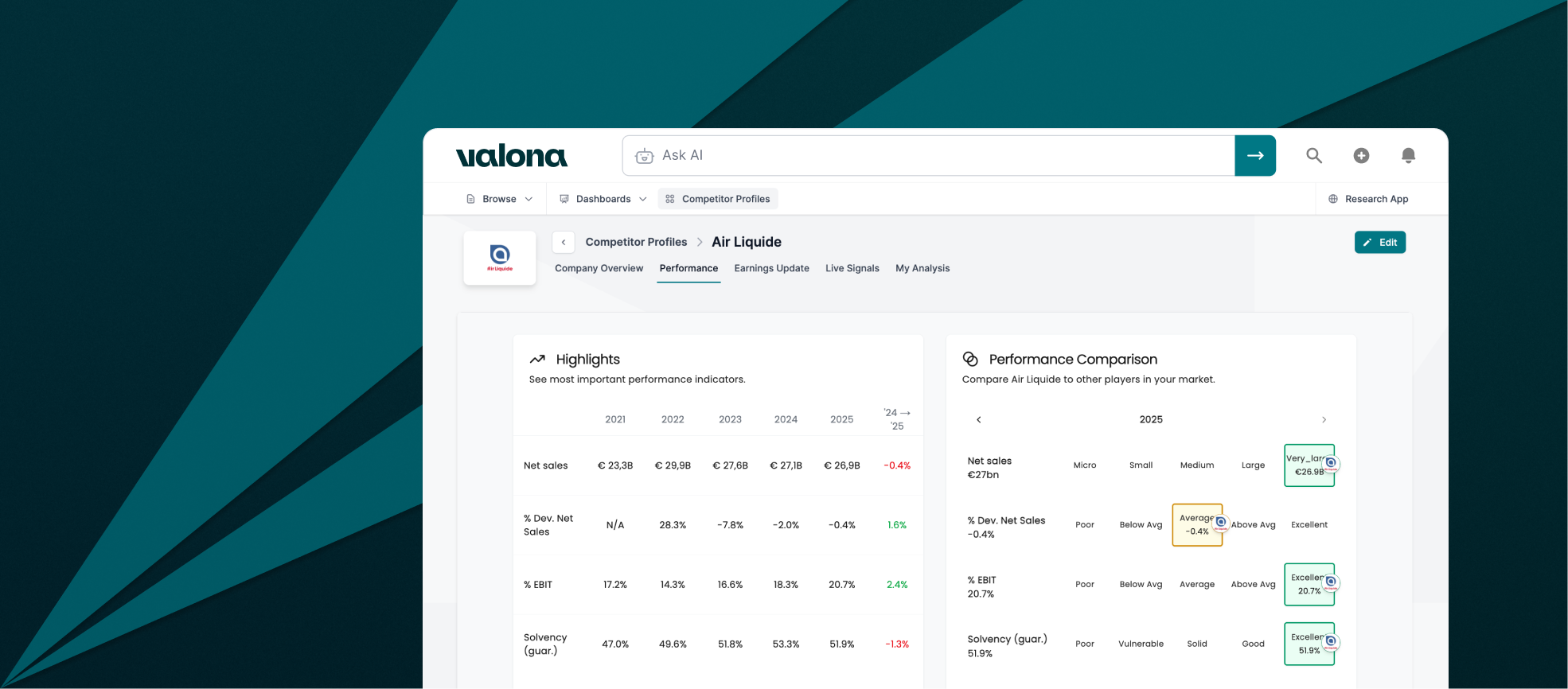
A company’s performance only means something next to competitors and the wider market — for strategy reviews, board updates, and everyday decisions alike. Revenue growth and margins tell you part of the story, but the more useful question is how those numbers look against competitors operating under the same conditions.
Is a slowdown company-specific, or is the whole market softening? Are you growing, but slower than your competitors? Answering that requires visibility into competitor growth, profitability, financial health, and operational metrics over time, not just your own results. A company profile that combines financial performance with peer comparisons provides the context needed to answer those questions quickly and consistently.
2. What do we know about this company?
One of the primary purposes of a company profile is to provide a reliable view of a strategically important company. Most organizations monitor a set of companies closely. Competitors are the obvious starting point, but the list typically extends to key customers, strategic suppliers, potential acquisition targets, and other important players across the value chain.
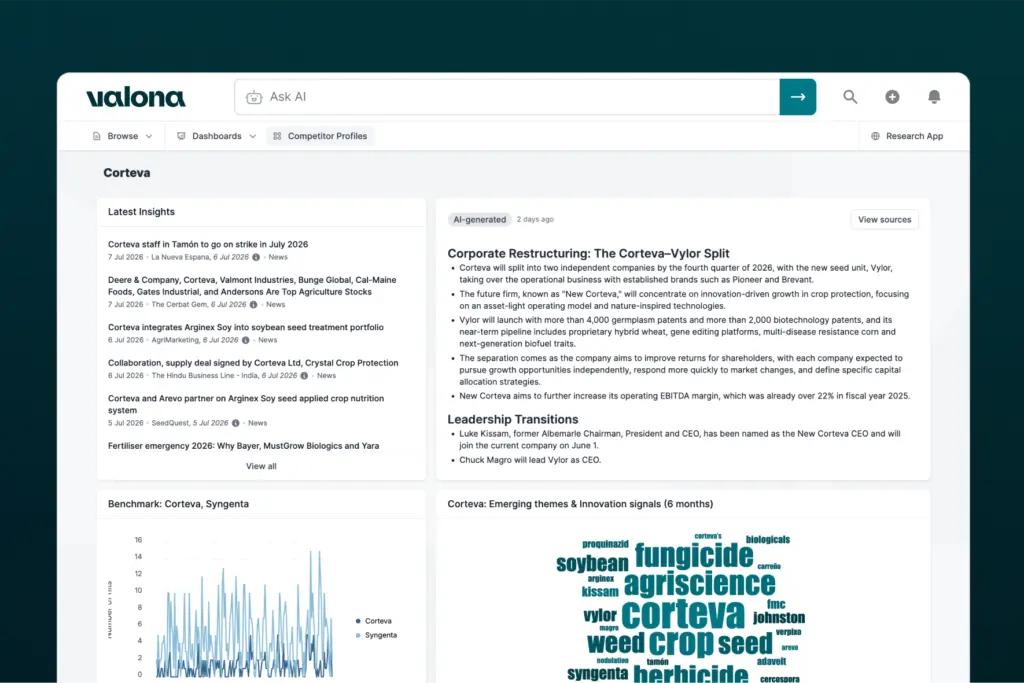
A meeting gets scheduled, a deal moves forward, or a competitor makes a move. Suddenly a handful of people across the business all need to understand that company, fast. They’ll need a clear view of the business and its strategy, performance, recent developments, and whatever institutional knowledge your sales and account teams already hold. That’s what a company profile should bring together in one place.
The challenge is knowing whether the company profile is still accurate when it’s needed most. Public companies generate an overwhelming volume of reports, filings, and market coverage. Private companies can be more opaque. Either way, the same questions come up: who’s responsible for updating the profile? When was it last reviewed? Has anything changed since? In most organizations, the honest answers are “no one in particular,” “a while ago,” and “probably.”
3. How significant is this announcement?
Something crosses your radar: a competitor is rumored to be moving into a new market, a company announces a major acquisition, or a key executive leaves. Does this matter?
The answer almost always depends on the company behind it. The same move can be a major strategic shift for one company and a routine footnote for another. How big are they? What have they been investing in? Does this fit their stated direction, or does it come out of nowhere? What else has been happening with them recently?
Without that context, it is hard to know what to do with the information. With it, you can make a faster, more grounded judgment about whether something is worth escalating, monitoring, or setting aside.
4. Why is this competitor winning or losing?
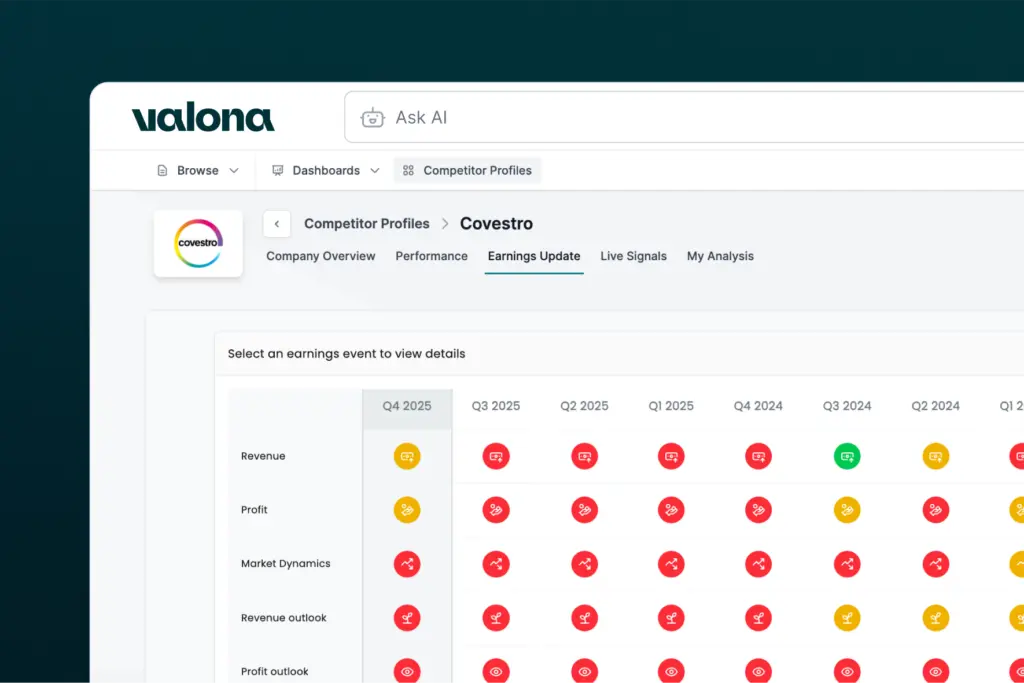
A company profile should help explain not only what changed, but why. Having the financial numbers is one thing. Understanding what they actually reflect is another.
A competitor posts strong revenue growth. Where is it coming from? A company’s margins are declining. Is it a cost issue, FX exposure, or something shifting strategically? Answering that takes more than the numbers themselves; it takes knowing what competitors are doing, what management is saying, and what strategic moves are already in motion. That’s the difference between reading a set of financials and understanding what’s actually happening inside a company.
5. How is the competitive landscape evolving?
Company profiles become even more valuable when they can be compared across an entire market. Which players are gaining ground? Who is pulling back? Are there new entrants or adjacent players starting to matter?
This is harder to answer than it sounds. Markets don’t send announcements when they start to shift. The signals tend to be gradual, a cluster of smaller developments across multiple companies that only add up to something when you look at them together.
That requires company profiles that cover a broader set of companies, not just the handful you monitor most closely, and make it easy to compare how they are developing over time.
From manual maintenance to a living view
Taken together, these questions point to something bigger than keeping a profile current. A company profile should do more than summarize basic facts about a business. It should help competitive intelligence and strategy teams build and maintain an accurate mental model of the market: how competitors, customers, suppliers, and other key players are developing and interacting, and how up to date that understanding truly is.
Answering all five well, for every company that matters, is a lot to keep up by hand: pulling in peer benchmarks, tracking significance, understanding the “why” behind the numbers, watching the wider market, all at once, and keeping it current as things change.
AI is changing what’s actually possible here. It’s now possible to maintain a living view of the companies that matter — continuously updated with new developments, performance data, earnings analysis, and organizational knowledge — so a company profile becomes less of a maintenance burden and more of a foundation your team can turn to in important decision moments.
Valona’s Company Profiles bring these elements together in a single, continuously updated view: company information, financial performance, peer comparisons, earnings analysis, market signals, AI-generated insights, and your organization’s own knowledge.
FAQ
01 What is a company profile in competitive intelligence?
A company profile in competitive intelligence is a structured view of a strategically important company. It brings together information about the company’s business, products and services, strategy, financial performance, recent developments, and other relevant intelligence to help competitive intelligence, strategy, sales, and leadership teams make better-informed decisions.
02 What should a company profile include?
A comprehensive company profile typically includes a company overview, business activities, products and services, strategic priorities, financial performance and peer comparisons, earnings analysis and management commentary, recent news and market signals, and internal knowledge gathered from sales, account teams, and analysts.
03 How do you keep competitor profiles up to date?
Competitor profiles stay relevant when they are continuously monitored and updated as new signals appear, such as earnings results, guidance changes, product launches, investments, leadership moves, and market developments. The best approach combines automated monitoring with analyst review, so the profile reflects both the latest facts and the strategic context behind them.
04 How do you analyze a competitor’s strategy, not just their financials?
Financial results show what happened, but competitor strategy analysis requires connecting those numbers with qualitative signals such as management commentary, earnings calls, product launches, partnerships, hiring, pricing moves, and market activity. By combining quantitative and qualitative data, you can understand not only a competitor’s performance, but also the strategic choices behind it and where they may be heading next.
05 Which companies should you profile for competitive intelligence?
Most organizations start with direct competitors, but the most useful profiles extend to key customers, strategic suppliers, potential acquisition targets, and adjacent players who could enter your market. The right set depends on your strategic priorities, but any company whose moves could meaningfully affect your business is worth profiling.