Industry Brief: Vegetable Seed H1 2026 Results
Vegetable seed market trends for H1 2026: what competitive and market intelligence reveals about breeding innovation, regional growth and resilience.
Since the International Seed Federation Conference in May and the close of H1, I have been reflecting on how the vegetable seed market is evolving in 2026.
Against a volatile and complex backdrop, growth remains under pressure and is becoming more concentrated in specific crops and regions, while resilience and speed to market are gaining importance.
H1 data across the sector helps to validate these three shifts:
1. International localisation moves further into execution
Recent financial reporting suggests that growth is becoming more geographically dispersed across major vegetable seed players (Figure 1).
During H1, companies continued to build local commercial and breeding capabilities in priority markets while also investing in major home-country facilities. Signals include Semillas Fitó opening a subsidiary in Egypt to strengthen customer relations in EMEA, and Rijk Zwaan inaugurating its 40-hectare breeding station in Mogi Mirim, Brazil, to support with breeding under tropical growing and disease conditions. Meanwhile, in Spain, Syngenta opened a $10 million R&D Technology Centre to bring field diagnostics, breeding and trait development closer to an important vegetable-production cluster.
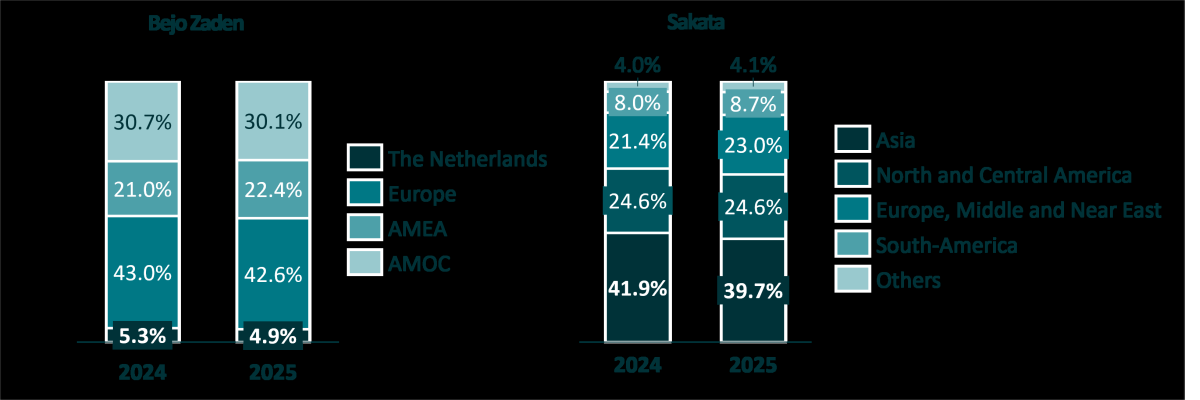
Figure 1: Reported regional revenue mix by company, 2024–2025
Together, these developments indicate that international localisation is extending beyond sales expansion into players’ innovation models. For competitors, this raises the strategic importance of maintaining well-run distributed breeding R&D and customer networks across their priority markets.
2. Weather and disease volatility push breeding towards integrated crop resilience
Weather and disease pressure both remained visible in H1. Western Europe recorded its hottest June on record, with dry conditions affecting several important growing regions.
At the same time, El Niño emerged and is expected to strengthen, increasing uncertainty around temperature and rainfall patterns. The impact was highlighted in company reporting, such as Kaneko’s H1 results which cited high summer temperatures, localized heavy rain and pest outbreaks as factors behind weaker crop quality this year. The longer-term breeding response is also tangible, for example Sakata opened its Ishigaki Research Station in June to evaluate varieties under harsher subtropical conditions.
Disease has continued to shape breeding priorities, through the development of durable, stacked solutions. In H1, Hazera highlighted its multi-gene approach to developing more durable ToBRFV resistance without compromising yield, quality or plant performance. Further, trials published in July 2026 by Syngenta demonstrated the potential role of resistant rootstocks within grafted tomato systems. ToBRFV also remained an active production threat, with Scotland reporting its first outbreak in June 2026.
These signals suggest that breeding priorities are broadening from individual resistance traits towards protecting crop performance across a wider range of weather and disease pressures. Maintaining yield and quality while strengthening resilience is therefore becoming a more important source of differentiation.
3. AI and genomics make R&D productivity a stronger competitive differentiator
What continues to stand out is how R&D-intensive the vegetable seed industry is, with Rijk Zwaan and Enza Zaden investing around 30% of annual revenue in research. The most immediate technology signals in Valona’s Foresight Radar (Figure 2) suggest that the next shift will not simply be higher spending, but the use of AI and genomics to make breeding faster and more efficient.
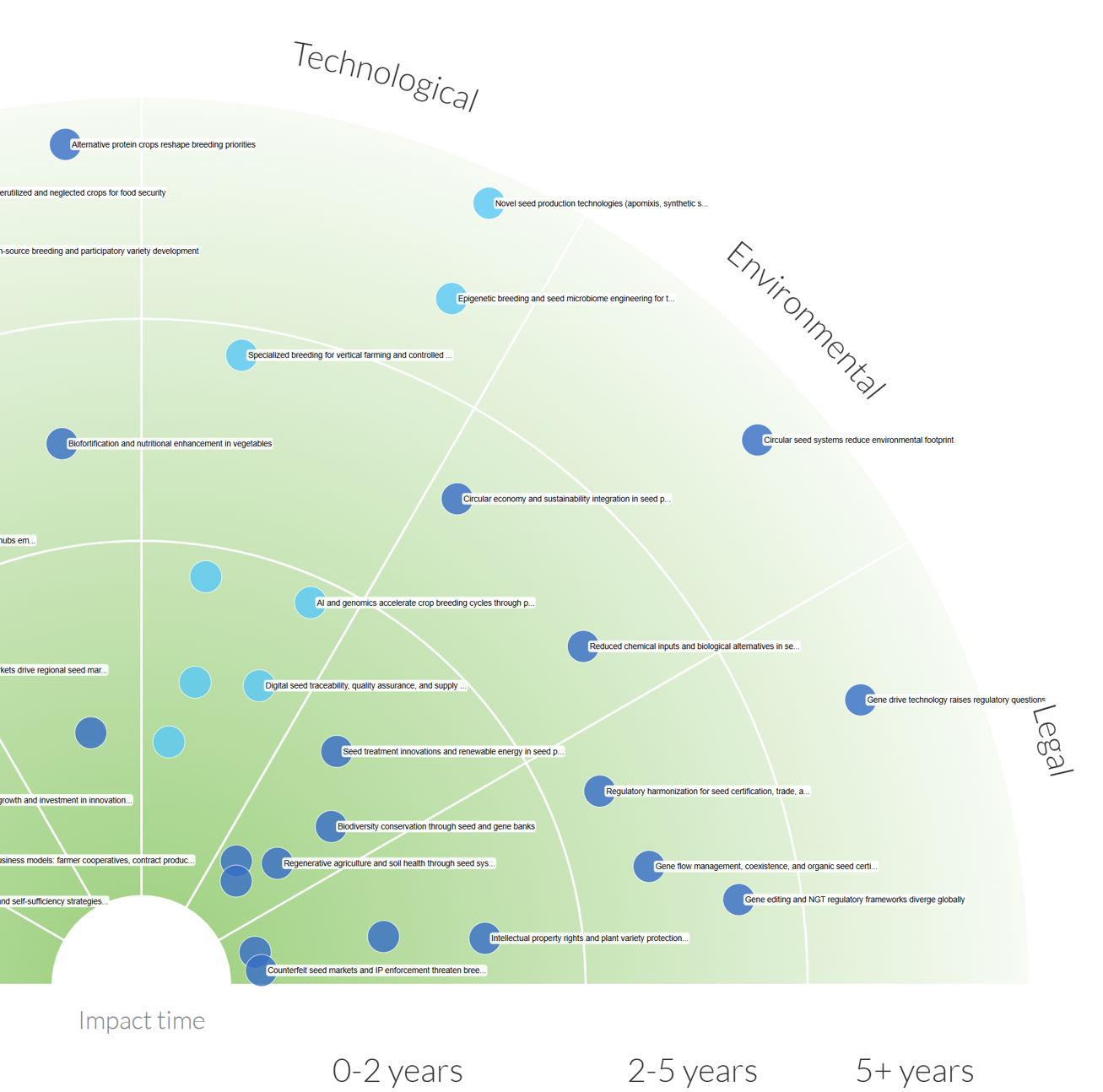
Figure 2: Selected view of Valona’s Foresight Radar, highlighting technology signals (light blue dots) by expected time to impact
H1 competitor moves show these capabilities moving into practice. Axia’s new research greenhouse enables multiple breeding trials to run simultaneously under tightly controlled conditions, while Syngenta’s TomatoVision combines AI with millions of data points on climate, yield and crop performance. The EU’s final approval of the NGT framework in June 2026 could further broaden the tools available to develop targeted traits more quickly.
AI and genomics are making R&D productivity an increasingly important competitive differentiator. Advantage will depend not only on how much breeders invest, but on how efficiently they turn data and genetics into commercially relevant varieties.
What to watch in H2
Alongside the three main themes, there are a few emerging signals I will be watching in H2. Public positions on NGT remain uneven, with KWS and Rijk Zwaan among the most vocal supporters, but the more telling sign will be whether this advocacy translates into named traits, field trials or licensing activity. Major capital-market developments also warrant attention. Syngenta’s proposed Hong Kong IPO has reportedly been delayed, with 2027 now considered more likely than Q4 2026, while BASF continues to prepare Agricultural Solutions for IPO readiness in 2027. Either process could influence capital allocation, portfolio priorities and the pace of investment in breeding.
Track vegetable seed market and competitive intelligence with Valona
The patterns in this brief didn’t emerge from a single announcement. They became visible by connecting competitor activity, market developments, financial performance and analyst expertise over time.
Valona continuously brings those signals together into trusted competitive and market intelligence—helping strategy, innovation and market intelligence teams understand what’s happening, what it means and what to do next.
Curious what these shifts look like in your own competitive landscape? See how Valona helps leading manufacturers understand what’s happening, what it means, and what to do next.
FAQs
Localisation is extending beyond regional sales coverage. Vegetable seed companies are investing in local breeding stations, research facilities, subsidiaries and customer networks in priority markets. These capabilities allow breeders to work more closely with local production clusters and develop varieties for specific climates, disease pressures and customer requirements.
Breeders increasingly need to protect crop performance against several pressures at once, including heat, drought, heavy rainfall, pests and disease. This does not replace breeding for individual resistance traits. Instead, varieties must combine resistance with stable yield, quality and plant performance across a wider range of growing conditions.
Key signals include whether support for new genomic techniques leads to named traits, field trials or licensing activity; whether investments in regional breeding capabilities translate into commercial growth; and how upcoming capital-market developments at major agricultural companies affect breeding budgets, portfolio priorities and the pace of innovation.