The Olin-Huntsman Merger Wasn’t a Surprise. It Was a Signal Few Connected
This brief breaks down the signals behind the Olin-Huntsman merger, the possible scenarios for further developments at BASF, Dow, Covestro, and Wanhua and how to build a system that catches the next one.
What the $12.5B Olin-Huntsman merger reveals about signal-to-scenario intelligence and which chemicals players should be scenario-planning their next move now.
On June 16, 2026, Olin and Huntsman announced an all-stock merger of equals a $12.5 billion combination that will fold Huntsman’s polyurethanes, amines, and epoxy businesses into Olin’s chlor-alkali platform, creating a new integrated North American chemicals leader called “OlinHuntsman”.
For many in the polyurethanes value chain, the deal landed as a surprise. It shouldn’t have. The signals were there for months — scattered across earnings calls, restructuring filings, and well-known structural gaps in Huntsman’s business model. The real story isn’t that nobody had the data. It’s that few connected it.
This brief breaks down those four signal layers — and, more usefully, what the deal changes for everyone still standing in the market.
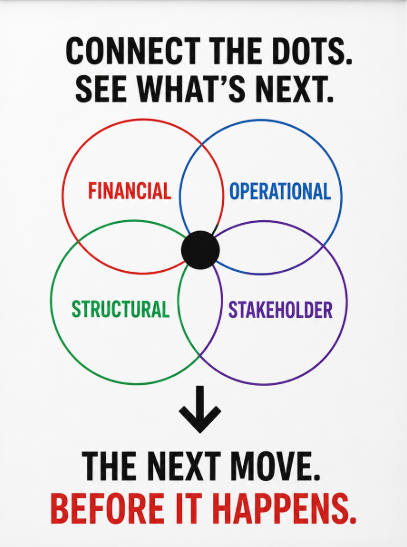
Four signals were visible for months. Few connected them.
Looking beyond the announcement itself, four distinct layers of signal were building well before June — each visible on its own, but only meaningful once read together.
- Financial distress was the easy signal Huntsman’s net leverage climbed to 6.1x by Q1 2026, triggering credit-rating downgrades. The dividend was slashed from $0.25 to $0.0875 per share in the same quarter. This is the most traditional kind of signal — the kind most CI functions already track — and it was flashing red well before the announcement.
- Operational retrenchment showed the trendline Starting in Q4 2024, Huntsman’s Polyurethanes segment began a restructuring program that expanded in Q2 2025 into a full overhaul of its European operations: plant closures in Germany and the UK, roughly 10% of the global workforce cut, and $148 million in restructuring charges for 2025 alone. No single closure was the story. The trendline was.
- The structural gap was common knowledge This is the layer that pure data-tracking would never catch, and it’s the most important one. Huntsman was, by its own CEO’s admission, the only major polyurethanes producer not integrated into chlor-alkali chemistry — unlike BASF, Dow, and Covestro, which all produce their own chlorine feedstock. That gap was common knowledge among industry insiders for years. It didn’t take proprietary information to see that Huntsman had a structural cost disadvantage and that a chlor-alkali producer with spare capacity — like Olin — was a logical partner to fix it.
- Stakeholder and macro pressure was building from multiple directions Activist investor Starboard Value had already pushed Huntsman on governance and performance back in 2021–22 — a recurring signal that the market doubted the standalone story. Layer on top of that a fast-moving macro backdrop: Chinese MDI capacity up 27% since 2023, with Wanhua alone adding 700,000 tons in 2026, and the US imposing 85.11% anti-dumping duties on Chinese MDI imports in April 2026. The competitive and trade environment around Huntsman was shifting fast, and the pressure to consolidate was building from multiple directions at once.
None of these four layers, on their own, screamed “merger.” Together, they triangulated toward one.
What the merger changes for everyone else
Spotting the signal is only step one. The more valuable exercise — and the one most intelligence function skip — is asking: now that this has happened, what does it change, and what are the plausible next moves for everyone else?
The integration gap closes, and the competitive floor moves.
Huntsman’s core disadvantage — buying chlorine at market prices while BASF, Dow, and Covestro produce their own — is being engineered away. Once OlinHuntsman is fully integrated (targeted by 2031, per management), one of the last major cost-structure gaps among top polyurethanes producers disappears. The bar for “competitive” moves up: any producer still exposed to market-priced feedstock is now the outlier, not Huntsman.
This may be the opening move in a wider shakeout.
Portfolio reviews are already running in parallel across the industry:
- BASF has sold its majority coatings stake to Carlyle and the Qatar Investment Authority while pushing toward $2.7 billion in annual cost cuts by end-2026;
- Dow posted a $657 million loss in January 2026 and announced 4,500 additional job cuts as part of a $2 billion cost program;
- SABIC is divesting its European petrochemicals business and its Engineering Thermoplastics unit in the Americas and Europe. Deal volume industry-wide is at a multi-year low (243 deals in H1 2025, the weakest half since before COVID) — but that quiet often precedes a wave once balance sheets stabilize.
- ADNOC agreed to acquire Covestro in a roughly €14.7 billion deal folding one of the world’s largest MDI producers, and one of the few already integrated into its own chlorine production, into a sovereign-backed platform.
Deal volume industry-wide is at a multi-year low (243 deals in H1 2025, the weakest half since before COVID) but that quiet often precedes a wave once balance sheets stabilize, and the ADNOC-Covestro deal suggests that wave may already be starting
The question worth scenario-planning isn’t “was Olin-Huntsman a one-off,” it’s “who is the next Huntsman” — not a single name, but a profile: mid-scale, feedstock-disadvantaged, carrying the same structural gap Huntsman had. The value isn’t in guessing who; it’s in knowing whether you’d recognize the pattern in time.
China remains the variable Western consolidation doesn’t solve.
Tariffs wall Wanhua out of the US, but its capacity keeps growing and nearly half its revenue already comes from overseas markets. Does it respond by pushing harder into Europe and other tariff-free regions, or accelerate its stated shift toward specialty chemicals to reduce MDI dependence? Either path reshapes the competitive map OlinHuntsman was just built to win.
For already-integrated players, the risk shifts from gap to scale.
A producer like Covestro doesn’t inherit Huntsman’s structural weakness — it already runs its own chlorine production across Leverkusen, Tarragona, and an expanding integrated site in Shanghai. But competing against a larger, newly-integrated North American player still changes the game on procurement leverage and regional cost positioning, especially in a market Fitch and others expect to stay oversupplied through 2026–27. The relevant question isn’t “are we exposed to the same gap” — it’s “what’s our counter-move once a competitor gets bigger and more efficient in our core markets.”
How to spot important M&As, repeatedly
The point was never to have predicted this specific merger. It’s to build the habit of scanning across all four signal layers at once — financial health, operational footprint, structural/value-chain positioning, and stakeholder pressure — for every major competitor, continuously, rather than reactively after a headline breaks.
And the second habit, arguably the harder one, is scenario discipline: for every meaningful signal, force the question “if this plays out, what are the two or three plausible next moves, and are we positioned to respond to each?” That’s the step that turns intelligence from a historical record into something that actually changes decisions.
Track chemicals market and competitive intelligence with Valona
Valona is built around connecting the hard data with the qualitative, structural read the data alone can’t give you, and using both to get ahead of the “so what” instead of explaining it after the fact.
The Olin-Huntsman merger wasn’t unpredictable. It was under-connected. Valona’s analysts continuously track the same four signal layers across your competitive set: financial, operational, structural, and stakeholder, and translate them into the scenarios that matter for your next move. See how Valona helps chemicals and manufacturing leaders know first, decide faster, and act with confidence.
For intelligence professionals, strategy VPs, decision-makers, and regulatory affairs teams in chemical manufacturing, the challenge is not access to information: it is the speed at which the picture changes and the scale of what needs to be tracked at once. Following the regulatory thread in isolation, without seeing how it connects to competitor moves and market signals, gives an incomplete view.