Why Dairy Leaders Are Betting on Protein
Cost pressure and stagnating margins are reshaping strategic priorities across the US and Europe, and dairy leaders on both sides of the Atlantic are landing on the same answer. Here are our findings on why protein has become the industry’s primary growth lever and margin driver.
Cost and volume growth are the priorities dairy leaders keep returning to
Dairy leaders in the US and Europe are running into the same challenges this year: hold the line on costs, defend margins, and find growth. Recent surveys and other market intelligence signals keep pointing at a clear answer for growth and more resilient businesses: Protein.
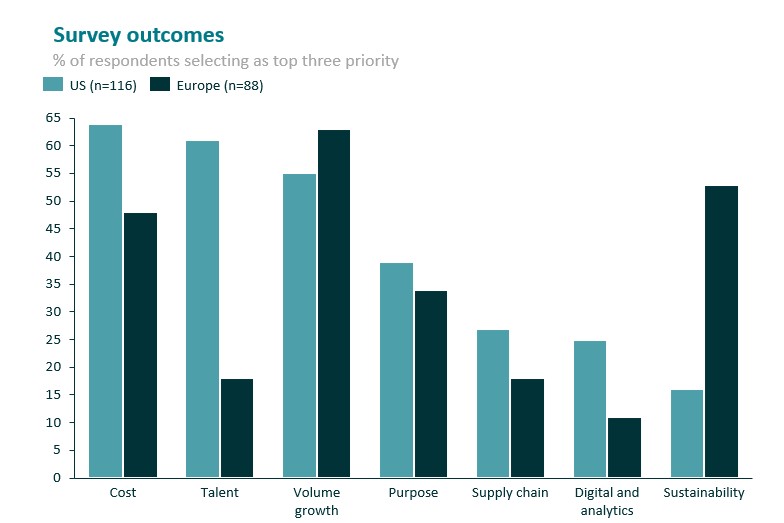
According to a survey by McKinsey & Company, cost management remains a top concern for dairy leaders on both sides of the Atlantic. 64% of US processors and roughly half of European processors rank it among their top three priorities, driven by elevated energy prices, higher fertilizer costs, and interest rate pressure tied to the ongoing Middle East conflict. That pressure is expected to persist through the rest of 2026 and into 2027.
Volume growth ranks just as high, with 55% of US and 63% of European leaders naming it a top priority. But confidence differs sharply by region: around 40% of European leaders expect volumes to stay flat or decline, against roughly 20% in the US.
That gap likely traces back to two separate issues. Europe is mainly dealing with slowing milk production outlooks, related to environmental regulations, while the US optimism is backed by a USDA forecast of milk production up 1.2% in 2026 and $11 billion in new dairy manufacturing capacity investment planned between 2025 and 2028, according to industry reports.
Dairy industry margins are already under strain
On top of the market volatility of recent years, elevated geopolitical instability is causing cost pressure which is showing in stagnating margins in 2026. According to the report mentioned above, the share of US-based companies reporting a year-on-year margin decline or no change rose every year from 2023 through 2025, reaching 68% by 2025 (29% decline, 39% no change). In Europe, 57% of leaders reported similar or lower margins in 2025, compared to the previous year.
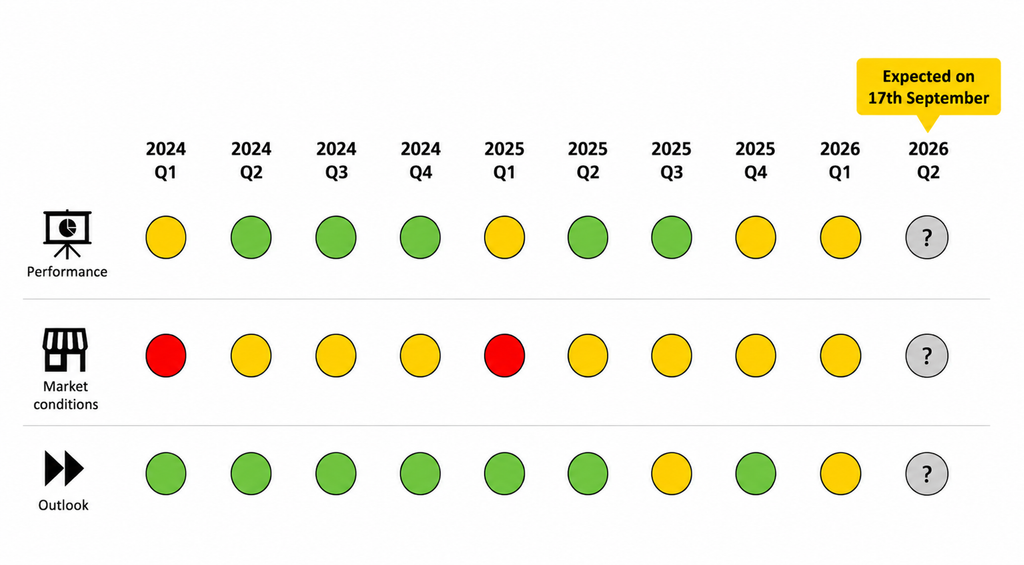
Our quarter-by-quarter monitoring of dairy companies’ earnings updates commentary provides another signal behind these margin concerns. By continuously tracking executives’ commentary across multiple performance, outlook and market axes, and combining it with reported financial performance, we spot changes in industry sentiment as soon as they emerge. Between Q1 2024 and Q1 2026, we saw sentiment improving in the first year, before it became progressively more cautious throughout 2025 and into 2026. By early 2026, all three indicators had converged around a more mixed/neutral view.
At the end of last calendar year, dairy leaders’ tone of voice reflected the challenging market circumstances in H2, and while they were mildly optimistic about anticipated margin increases at the beginning of 2026, cautiousness related to global geopolitical instability led to overall mixed sentiments in the presentation and comments on the Q1 earnings.
As a result, US companies report that they are making strategic or operational changes, like switching supplier and rationalizing SKUs. In Europe, leaders reported portfolio rationalization as an important strategic lever, as well as changing the geographic distribution of their products. Also, some companies have flagged that with rising input costs, price renegotiations will shortly become inevitable.
Together, these signals point to an industry that is more cautious about current conditions, while still actively positioning for growth. The question is where dairy companies see enough demand and pricing power to turn that confidence into stronger margins. Increasingly, the answer is protein.
Protein is the dairy industry’s answer to stagnating margins
Against the backdrop of stagnating margins, protein is being treated as the primary route back to growth. 80% of US dairy executives now cite protein as the most influential consumer demand trend, ahead of convenience, premiumization or plant-based alternatives.
That confidence is visible in recent capital allocation and strategic moves. Investments to expand capacity of dairy ingredients, including whey and specialized nutrition, are widespread, frequently taking center stage in company reports and financial results. For example at Dutch dairy giant Royal FrieslandCampina.
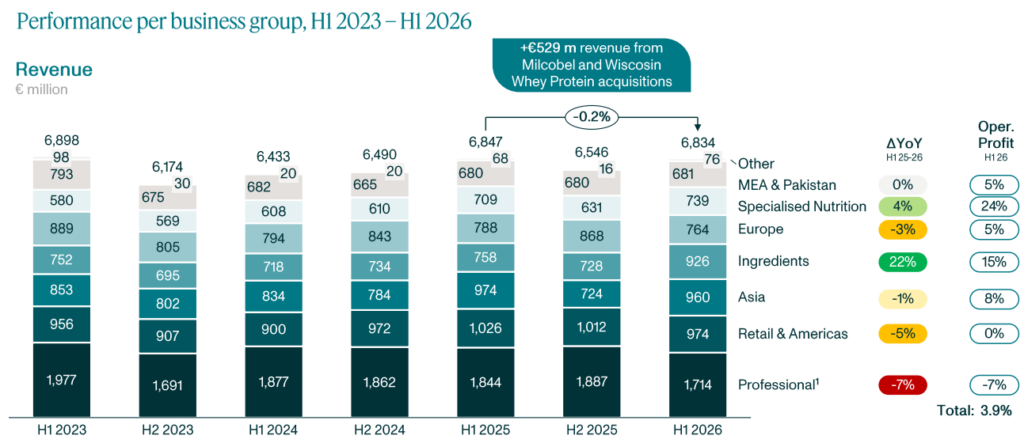
In the first half of 2026, the company realized nearly flat net sales compared to H1 2025, despite downward pressure from a challenging market. In addition to the Milcobel merger, this was largely attributable to the company’s acquisition of Wisconsin Whey Protein and strong performance of its Ingredients division (see the chart below). On top of the acquisition, a move made to strengthen its global protein position, the company announced a €90 million investment program that aims to expand internal capacity of premium protein ingredients for performance, active, early life, and medical nutrition.
Arla is another example of a leading dairy company that has been making significant moves in the ingredients space. The company’s ingredient division is its key growth engine that aims to sustain double-digit growth and wants to become a global leader in value-added whey solutions. These ambitions are reflected in recent actions. One of those is the contract manufacturing agreement it entered with Valley Queen Cheese (2025), to make Arla’s patented high-protein whey ingredients that will help fulfil growing demand for protein in North America. Also, the recently finalized merger with DMK now makes the combined company one of the top 3 global whey players.
Other examples of companies investing in whey capacity are Glanbia, Tirlán, and Land O’Lakes. And the list goes on way beyond that, underpinning that protein is being leveraged as a key counterweight to market volatility and margin pressure.
This shift toward protein is part of a broader repositioning of the dairy industry. In our recent webinar, Dairy in a VUCA World: A European Market Briefing, we explored how constrained milk supply, changing product mixes, global trade dynamics and sustainability pressures are pushing European dairy companies toward higher-value categories. Watch the webinar for the broader market context behind the protein shift.
What this means for dairy strategy
Cost pressure and market volatility gave dairy leaders a problem. Protein is becoming the answer with real commercial traction behind it. This shift is not happening in dairy alone. Broader food and beverage data shows GLP-1 adoption is accelerating demand for protein-forward, functional and portion-controlled products across categories. We explore that wider shift in our article, What the Data Says About GLP-1s, Trade, and Regulation.
However, the big question is, can whey production keep pace with the demand this strategy assumes? Despite all the announced investments, we have seen supply-side challenges around whey proteins already. This year, prices of whey protein isolates hit record highs, as demand accelerated while additional capacity will come online in the coming years.
Track dairy market and competitive intelligence with Valona
The patterns in this brief didn’t come from a single source. They became visible by connecting cost data, margin trends, and strategic priorities across regions and over time.
Valona brings those signals together into continuous, validated competitive and market intelligence, helping strategy, innovation and market intelligence teams understand what’s happening in dairy industry, what it means, and what to do next.
Curious what this looks like for your own category? See how Valona helps global food and beverages industry stay ahead of shifts like these.
FAQs
Energy, fertilizer and interest rate costs have all risen, driven largely by the ongoing Middle East conflict, and that pressure is expected to persist through 2026 and into 2027. According to McKinsey, 64% of US processors and roughly half of European processors now rank cost management among their top three strategic priorities, up sharply from prior years.
Around 40% of European leaders expect volumes to stay flat or decline, compared with roughly 20% in the US. Europe faces slowing milk production and farm-level labor shortages constraining supply, while the US benefits from a USDA forecast of rising milk production and billions in new manufacturing capacity investment.
Beyond cost and margin figures, intelligence teams should track how regional priorities diverge (talent versus sustainability, volume confidence) and how quickly companies convert survey sentiment into action, such as supplier switching or portfolio rationalization. These are earlier signals of strategic direction than quarterly results.