
What is market research process? A practical guide
Learn the market research process step by step, from planning and selecting research methods to validating findings and applying insights to business decisions.
Market research helps organizations replace assumptions with evidence. Whether the goal is launching a new product, entering a new market, evaluating an acquisition, or responding to changing competitive dynamics, market research provides the insights needed to make more informed business decisions.
This guide explains the modern market research process, from defining business questions and selecting the right research methods to validating findings and turning insights into strategic action.
What is market research?
Market research is the systematic process of collecting, analyzing, and interpreting information about customers, competitors, markets, and broader industry dynamics. It helps organizations answer specific business questions, validate assumptions, and make more informed strategic decisions.
Modern market research goes far beyond customer surveys. It combines primary research, secondary research, competitor analysis, market data, and industry insights to build a reliable evidence base for business decisions.
Every successful market research project starts with a clear business question. The research methods, information sources, and analysis should all be selected based on the decision the organization is trying to make.
When should you conduct market research?
Organizations that treat market research as an ongoing business capability rather than a one-time project are better equipped to identify new opportunities, adapt to changing market conditions, and make more informed strategic decisions
Market research is most valuable before making important business decisions. Rather than relying on assumptions, organizations use research to understand markets, validate ideas, and reduce uncertainty before committing significant time and resources.
Common situations where market research provides value include:
- Launching a new product or service: Validate customer needs, pricing, positioning, and demand before launch.
- Entering a new market or region: Assess market attractiveness, customer demand, competitors, and regulatory considerations.
- Developing or refining a go-to-market strategy: Test messaging, target segments, and buying behavior before investing in commercial activities.
- Evaluating strategic investments, partnerships, or acquisitions: Use market research to assess market potential, competitive dynamics, customer demand, and strategic fit before making investment decisions.
- Understanding competitors: Analyze competitor positioning, product launches, investments, partnerships, and market strategies.
- Improving existing products and services: Gather customer feedback, identify unmet needs, and understand changing usage patterns to guide product development.
The measurable impact of market research
Market research helps organizations reduce uncertainty by replacing assumptions with evidence. It supports better strategic decisions by improving customer understanding, identifying market opportunities, reducing decision risk, and strengthening competitive positioning.
The value of market research isn’t measured only by the opportunities it identifies, but also by the costly mistakes it helps organizations avoid. Preventing an unsuccessful market entry, product launch, or acquisition can often deliver greater value than any single commercial success.
Organizations use market research to:
- Validate assumptions before major business decisions
- Identify growth opportunities and emerging market trends
- Better understand customers and buying behavior
- Analyze competitors and market dynamics
- Prioritize investments and strategic initiatives
For a deeper look at how market research supports business growth, including practical examples, see our guide on Why market research is important for business growth.
Planning an effective market research process
Successful market research starts long before data collection. The quality of the insights you generate depends on asking the right questions, choosing the right methods, and maintaining a clear focus on the business decision you’re trying to support. Investing time in planning helps ensure the research is both relevant and actionable.
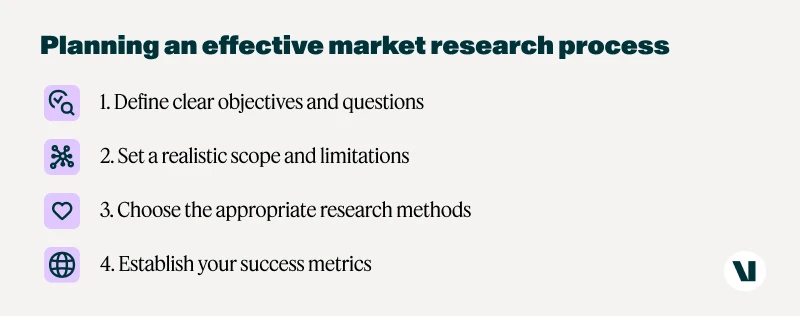
1. Translate information needs into focused research questions
Start with the business decision, not the data. Define the strategic question the research needs to answer, then translate it into clear research objectives and questions.
- Identify specific business challenges that need addressing
- Understand what different stakeholders need from the research
- Consolidate multiple information needs into clear research questions
- Stay focused rather than trying to gather all possible information
2. Set a realistic scope and limitations
Trying to answer every question in one project often produces weaker insights than focusing on the decisions that matter most.
- Start with a broad view before diving into specifics
- Define clear parameters for what will and won’t be covered
- Consider available resources and time constraints
- Plan for both immediate and long-term information needs
3. Choose the appropriate research methods
The right methodology depends on the business question. Most projects combine secondary research to build context with primary research to validate assumptions or fill knowledge gaps.
- Determine the right mix of primary and secondary research methods.
- Consider which sources will provide the most reliable data
- Plan for ongoing validation across multiple sources
- Ensure methods align with objectives and available resources
4. Establish your success metrics
Success isn’t measured by the amount of data collected, but by whether the research enables better decisions. Define upfront what evidence is needed, how findings will be validated, and how the results will influence the business decision.
- Set clear KPIs that align with business objectives
- Plan how results will be measured and validated
- Consider both quantitative and qualitative success indicators
Starting with a broad view before narrowing it down to specifics often brings about better results.
For example, when evaluating market entry across multiple countries, resist the urge to analyze every market simultaneously. Instead, first determine what makes a market attractive for your business, then use those criteria to identify the most promising opportunities for deeper investigation.
Primary research and secondary research
Market research methods broadly fall into two categories: primary research (direct data collection) and secondary research (analysis of existing data). Most market research projects combine both primary and secondary research. The right mix depends on the business question, the availability of reliable information, and the resources available.
Primary research: direct data collection
Primary research involves collecting original data directly from the source. It’s particularly valuable when existing information is unavailable, outdated, or insufficient to answer a specific business question. In emerging markets, fast-moving technologies, or highly specialized B2B sectors, primary research may be the only reliable way to understand customer needs, market dynamics, or competitive developments.
Common primary research methods include:
- Customer and prospect interviews
- Surveys and questionnaires
- Focus groups and workshops
- Expert interviews
- Product testing and observations
- Behavioral observation and product usage analysis
Qualitative methods such as interviews and workshops help researchers understand not only what customers think, but why they think it, providing context that quantitative data alone cannot capture.
Secondary research: existing data analysis
Secondary research uses information that has already been collected by other sources. It helps organizations understand market dynamics, customer trends, competitors, and industry developments before deciding where additional primary research is needed.
Common secondary research sources include:
- Industry reports and market studies
- Government databases and statistics
- Academic research papers
- Trade publications and news sources
- Company websites, annual reports, and regulatory filings
- Competitor analysis and benchmarking
The strongest market research projects combine both approaches. Secondary research establishes context and identifies knowledge gaps, while primary research tests assumptions, answers specific questions, and generates insights that aren’t available from published sources.
One of the most valuable, and often overlooked, sources of market research is your existing customer base. Conversations with current customers can reveal unmet needs, product improvement opportunities, buying behavior, and competitive insights that are difficult to uncover through secondary research alone.
Choosing the right mix of methods depends on your objectives, timeline, and the type of insight you’re looking for. Learn more about the main types of market research.
Validating market research findings
The value of market research depends on the quality of the evidence behind it. Decisions based on incomplete, outdated, or biased information can be just as risky as making decisions without research at all. Validation helps ensure that findings are accurate, relevant, and trustworthy before they’re used to support strategic decisions.
Use multiple trusted sources
No single source provides a complete picture of a market. Effective market research compares information from multiple trusted sources to identify consistent patterns, validate findings, and reduce the risk of bias or inaccurate conclusions.
- Cross-checking findings across independent sources
- Comparing qualitative and quantitative evidence
- Validating primary research against secondary research where possible
- Assessing the credibility, relevance, and timeliness of each source.
Validate continuously
Validation isn’t a one-time activity. As new information becomes available, organizations should revisit assumptions, investigate conflicting evidence, and ensure conclusions remain supported by the latest available information.
Good practices include:
- Reviewing findings as new evidence emerges.
- Investigating conflicting or inconsistent information.
- Documenting sources and research methods.
- Updating conclusions when market conditions change.
Technology’s role in modern market research
AI has fundamentally changed what’s possible in market research. Research that once took weeks can now be completed in days or even hours, and organizations can analyze far more information than was previously practical. But faster research doesn’t automatically mean better research. Human expertise remains essential for framing the right questions, evaluating evidence, and turning findings into sound business decisions.
The most effective market research combines the strengths of both AI and human expertise.
How AI supports market research
AI can help accelerate market research by:
- Synthesizing information from multiple sources
- Identifying relevant trends, patterns, and recurring themes
- Comparing competitors, markets, customer segments, or strategic options
- Producing first-pass summaries and research reports
- Visualizing research findings through charts, matrices, timelines, and other formats that make complex information easier to interpret
- Highlighting knowledge gaps and opportunities for further investigation
- Supporting deeper exploration through AI-powered research workflows
Where human expertise adds value in market research
- Defining the business question and research objectives
- Designing primary research and selecting appropriate research methods
- Assessing the credibility, quality, and relevance of evidence
- Interpreting findings within business context
- Challenging assumptions and validating conclusions
- Tailoring research outputs for different audiences, making findings easier to communicate, share, and act on across the organization.
- Translating research into strategic recommendations
While AI enables faster research and analysis, organizations must continue to balance speed with research quality. Rapid insights are valuable only when they are based on reliable sources, sound methodology, and careful validation.
The key is combining both: use technology to handle data collection and initial processing, while relying on human expertise for interpretation and strategic recommendations.
Common market research applications
Market research supports a wide range of strategic business decisions. While the research process remains largely the same, the questions, data sources, and methods vary depending on the objective. Below are some of the most common applications of market research in enterprise organizations.
Market sizing and forecasting
Market sizing helps organizations estimate the size, growth potential, and attractiveness of a market. It supports decisions such as entering new markets, prioritizing investments, evaluating acquisitions, and setting growth targets. Market sizing typically combines secondary research, primary research, and analytical modelling to estimate market potential and validate assumptions.
For a detailed guide, see our article on how the best strategy teams approach market sizing.
Customer research in B2B context
B2B customer research helps organizations understand both their existing customers and the customers they want to reach. It provides the insights needed to improve products and services, strengthen customer relationships, and identify opportunities in new markets.
Unlike consumer research, B2B studies often involve multiple stakeholders, longer buying cycles, and more complex purchasing decisions.
Research with existing customers helps organizations:
- Understand evolving customer needs and priorities
- Identify unmet needs and product improvement opportunities
- Map buying journeys and decision-making processes
- Improve customer satisfaction and retention
- Validate new products, services, or concepts before launch
Research with prospective customers helps organizations:
- Assess demand in new markets or customer segments
- Understand how different buyers evaluate solutions
- Identify barriers to adoption and purchasing criteria
- Refine market positioning and go-to-market strategies
- Prioritize the most attractive customer segments
As B2B buying journeys become increasingly self-directed, customers often research solutions, compare alternatives, and define their requirements before engaging suppliers. Market research helps organizations understand how buyers discover, evaluate, and select solutions, allowing them to better align products, messaging, and commercial strategies with changing customer behavior.
Competitive analysis
Competitive analysis helps organizations understand how competitors are positioned today, where they are investing for the future, and what those developments could mean for the market. It supports strategic decisions across product development, pricing, market entry, M&A, investment planning, and long-term business strategy.
Depending on the business question, competitive analysis may focus on a single competitor, a market segment, or the broader competitive landscape.
Effective competitive analysis combines systematic monitoring with strategic interpretation. Organizations track a broad range of competitive signals—including product launches, pricing changes, partnerships, acquisitions, financial performance, earnings reports, leadership changes, hiring activity, patent filings, and geographic expansion—and analyze what those developments reveal about competitors’ priorities and likely future direction.
The strongest analyses also examine competitors’ underlying capabilities and constraints, such as technology, manufacturing capacity, supply chains, distribution networks, financial resources, and geographic reach. These often provide a better indication of future competitive advantage than individual announcements alone.
Common outputs include competitor profiles, market landscape assessments, benchmarking reports, positioning maps, SWOT analyses, and win/loss analyses. Because competitor information changes continuously, many organizations complement periodic competitive analysis with continuous monitoring, allowing analysts to spend less time gathering information and more time interpreting strategic developments.
Common challenges when conducting market research
Even well-designed market research projects face practical challenges. Organizations must define the right questions, balance one-off research with ongoing market awareness, and translate findings into decisions that create business value.
Defining the right research question
Market research delivers the greatest value when it informs decisions before they are made, rather than validating decisions that have already been taken. One of the most common challenges is trying to answer too many questions in a single project, leading to unfocused research and findings that are difficult to act on.
The most effective projects begin with a clearly defined business objective and a small number of priority research questions. This helps organizations select appropriate research methods, make better use of available resources, and generate insights that directly support decision-making.
Balancing ad hoc research with continuous market awareness
Market research is often conducted to answer a specific business question, such as evaluating a new market, validating a product concept, or assessing competitors. However, customer needs, competitor strategies, regulations, and market conditions continue to evolve long after a research project has been completed.
Organizations therefore need to balance one-off research with ongoing market awareness. While not every business question requires continuous monitoring, maintaining regular visibility into customers, competitors, and market developments helps identify when earlier research should be revisited and supports faster, more informed decisions.
For practical guidance on building a more continuous approach to market research, see our article on best practices for continuous improvement in market research.
Turning information into actionable insights
The challenge is rarely finding information—it’s determining what matters and translating research into decisions. Market research creates value only when findings influence business actions, whether that’s entering a new market, refining a product strategy, adjusting pricing, or prioritizing investments.
Effective market research goes beyond presenting data. It connects evidence to specific business questions, explains what the findings mean, and provides clear recommendations that decision-makers can act on. Throughout the research process, regular collaboration between researchers and stakeholders helps ensure the work remains aligned with business objectives and can be refined as new insights emerge.
Technology and AI can help gather, organize, and synthesize information more efficiently, but human expertise remains essential for interpreting findings, validating conclusions, and communicating insights in a way that different stakeholders can understand and act upon.
Presenting findings in formats that are tailored to different audiences, such as executive summaries, dashboards, or detailed reports, helps ensure insights are understood and applied across the organization.
Market research vs. market intelligence
Market research and market intelligence are closely related but serve different purposes. Market research is typically conducted to answer a specific business question, such as evaluating a new market, testing a product concept, or understanding customer needs. It provides focused insights at a particular point in time.
Market intelligence builds on that foundation by continuously monitoring customers, competitors, markets, and external developments. Rather than answering a single question, it helps organizations maintain an up-to-date understanding of the business environment and identify changes that may require action.
The two approaches are complementary. Organizations often use market research to investigate specific opportunities or challenges, while market intelligence keeps those insights current as market conditions evolve.
Learn more about how market research and market intelligence work together in our guide to market intelligence.
Moving forward with your market research process
Effective market research doesn’t require answering every question at once. The most successful projects start with a clearly defined business objective, select appropriate research methods, validate findings using multiple sources, and translate insights into decisions that create business value.
As organizations mature, market research often evolves from one-off projects to a more continuous process of monitoring customers, competitors, and market developments. Combining focused research with ongoing market awareness helps organizations make better decisions in changing markets.
Organizations that consistently make better strategic decisions don’t just conduct market research—they build the capability to continuously understand their markets. Learn more in our guide to building a competitive intelligence program that shapes decisions.
FAQ
Market research is the process of systematically collecting, analyzing, and interpreting information about customers, competitors, markets, and industry trends to support better business decisions. Organizations use market research to understand customer needs, evaluate new market opportunities, validate product ideas, optimize pricing, and reduce business risk. Common examples of market research include customer surveys, focus groups, interviews, competitor analysis, usability testing, and industry research.
Market research typically includes two approaches:
Primary market research, which gathers new information through surveys, interviews, focus groups, and customer observations.
Secondary market research, which analyzes existing information such as industry reports, market studies, government statistics, competitor websites, and published research.
Many organizations combine both approaches to gain a more complete understanding of the market.
Market research should be conducted regularly and whenever significant business decisions are being made, such as launching a new product, entering a new market, evaluating customer satisfaction, or refining a pricing strategy. While individual research projects answer specific business questions at a point in time, repeating them periodically helps organizations keep pace with changing customer needs and market conditions. For continuous visibility into competitors, trends, and market developments between research projects, many organizations complement market research with an ongoing market intelligence program.
Market research draws on a wide range of data, including primary sources like customer surveys and expert interviews, and secondary sources such as CRM and sales records, competitor and industry information, general news and trade publications, economic and market trend data, and company filings and financial data. Combining multiple, well-sourced data types improves the reliability of the findings and the decisions built on them.
AI helps organizations collect, organize, and analyze large volumes of market data more efficiently. It can automatically identify trends, summarize research, monitor competitors, categorize information, and surface insights that might otherwise be overlooked. This enables researchers to spend more time interpreting findings and making strategic recommendations instead of manually gathering data.

Develop your strategic foresight
The ‘Strategic Foresight Playbook’ includes 9 activities with templates and supplemental materials for you and the strategic thinkers on your team to plan ahead for what’s to come.