
Medical Device Trends 2027: 4 Shifts and the Decisions They Force
The four medical device trends shaping 2027 are connectivity becoming a platform expectation, EU and US regulation forcing product-by-product decisions, tariffs splitting supply chains by region, and new business models crowding profitable segments. Each brings decisions due within 24 months and signals that competitive intelligence for medical devices can track now.
That overlap is what makes the current trends in the medical device industry different from earlier cycles. Each trend brings decisions due within 24 months, and signals worth monitoring now.
Medical device companies are planning 2027 with more moving parts than usual. The product roadmap, the certification plan, the production footprint and the pricing model are all under pressure at the same time. A decision in one area now changes the options in the others.
That overlap is what makes the current medical device industry trends different from earlier cycles. Connectivity is turning from a feature into infrastructure. Regulators in Europe and the US are tightening at once. Tariffs are redrawing supply chains. And in segments that pay well, the business model is starting to matter more than the device.
This article draws on the latest trend analysis from Valona Intelligence’s medtech experts. For each trend, it sets out the evidence, the decisions leaders face and when, and the signals worth monitoring. It ends with a full checklist of what to monitor in 2027 and a short overview of how competitive intelligence for medical devices supports those decisions.
What are the biggest medical device industry trends for 2027?
The four medical device industry trends that matter most for 2027 are:
- Connectivity becomes a platform expectation. AI-enabled and connected devices are moving from premium option to baseline requirement, led by imaging and endoscopy.
- Regulation forces product-by-product choices. EU MDR and IVDR deadlines and new US rules on quality, AI and cybersecurity stack up between 2026 and 2028.
- Geopolitics splits the supply chain by region. US tariffs, China’s central procurement and cost shocks push production away from single low-cost hubs.
- New business models redraw competition. As-a-service models and new entrants turn profitable segments from blue ocean into red ocean.
These medical device trends are connected. A tariff decision changes production cost, which changes which products are worth recertifying for the EU. A rival’s connected platform changes what hospitals ask for in their next tender. Medtech trends are easiest to act on when they are monitored together, not one at a time.
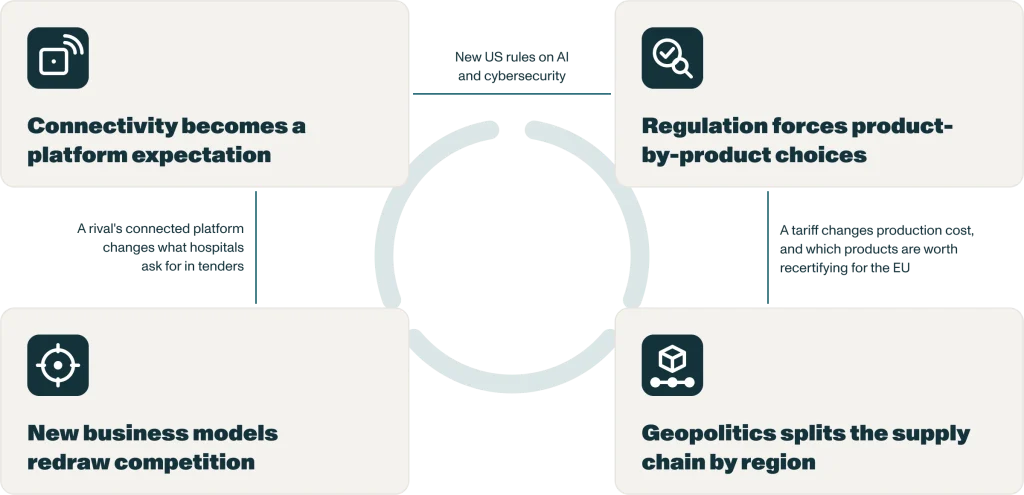
Figure 1. Medical device trends interconnectivity
How is medical device connectivity changing medtech strategy?
The short answer: Medical device connectivity is moving from a premium option to an expected platform capability. Hospitals increasingly expect AI-enabled, connected devices, especially in imaging and GI endoscopy. For manufacturers, that turns AI and connectivity from a product feature into a strategic choice about platforms, partners, data and cybersecurity.
The evidence
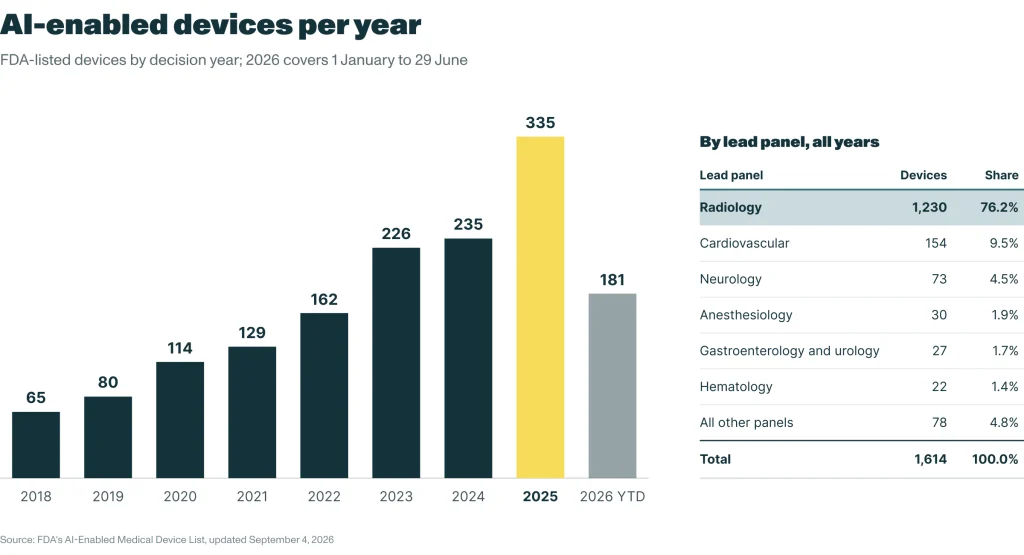
The clearest measure is regulatory. The number of AI-enabled devices authorized by the FDA each year grew fivefold between 2018 and 2025, from 65 to 335. By 29 June 2026, another 181 had been authorized, putting the year on track for a new high (FDA AI-Enabled Medical Device List, as of September 2026). Radiology accounts for 76% of all 1,614 devices on that list.
Product launches show where the market is heading. In imaging, Canon Medical has brought deep-learning reconstruction to its workhorse CT scanners, and GE HealthCare has added AI features to compact laptop ultrasound. In endoscopy, Olympus has extended its cloud-based colonoscopy AI to real-time polyp sizing. Once AI reaches the mid-range of a portfolio, connected medical devices stop being a differentiator and become the entry ticket.
This is also where strategy teams feel most exposed. In conversations with medtech teams, a recurring concern is missing a fast-moving digital segment until a competitor has already launched in it.
Decisions leaders face, and when
Valona’s experts expect competitors to move from “AI as an add-on” to “AI as connected infrastructure” within the next 12 to 18 months. Before then, leaders need to decide whether to build or partner on AI, whether to sell it as a standalone product or integrate it into a system, and how much to invest in the cybersecurity and data strategy that connected devices depend on.
Signals to monitor
- Competitor messaging that repositions AI from a feature to a platform
- Tender criteria, GPO contracts and reimbursement decisions that start to require AI capability
- New FDA authorizations and CE marks for AI-enabled devices in your product codes
- Cybersecurity requirements from regulators and hospital buyers
How will EU MDR, IVDR and US regulatory change affect medical device companies?
The short answer: EU MDR and IVDR deadlines and new US rules on quality, AI and cybersecurity will force medical device companies to decide, product by product, whether to recertify, redesign or withdraw. Most of those choices are due by 2027. Companies that decide early secure certification capacity, while late applicants risk losing market access.
The evidence
In Europe, the bottleneck is capacity. About 50 notified bodies certify devices under EU MDR and IVDR (EU NANDO register, 2026), and the EU extended its transition deadlines three times between 2022 and 2024 for lack of capacity (Regulations (EU) 2022/112, 2023/607 and 2024/1860). The extensions moved the deadlines without removing them. Last applications for Class B diagnostic tests are due in May 2027, Class III devices such as heart valves follow in December 2027, the EU AI Act applies to AI-enabled devices from August 2028, and Class IIa and IIb devices such as infusion pumps follow in December 2028. A mixed portfolio can hit several of these at once.
The US is tightening in parallel. Since 2023, the FDA can refuse submissions that lack cybersecurity evidence (FD&C Act section 524B), and since February 2026 its quality system rules follow ISO 13485 (QMSR). Approval is only part of the picture. Recalls, reimbursement decisions and updated clinical guidelines on both sides of the Atlantic decide whether a cleared device actually sells.
This is where medical device regulatory intelligence earns its place. Following rules, competitor certifications, recalls and reimbursement continuously means certification decisions are timed, not forced.
Decisions leaders face, and when
For each product, manufacturers must choose whether to recertify it for the EU, redesign or replace it, or withdraw it, with most decisions due by 2027. An early decision is often what secures a notified body slot. The same review sets the market entry order between the EU and the US, and shows where competitor withdrawals could open market share.
Signals to monitor
- Competitor certifications and withdrawals under EU MDR and IVDR, product by product
- FDA clearances, recalls and guidance on AI and cybersecurity
- MDCG documents and notified body statements on capacity
- Reimbursement decisions and clinical guideline updates in priority markets
- The EU MDR and IVDR revision expected in 2027
How are tariffs and geopolitics reshaping the medical device supply chain?
The short answer: US tariffs, China’s local-first procurement and Middle East cost shocks are pushing medical device makers away from single low-cost hubs and toward regional production. The medical device supply chain is becoming a strategic choice about where to build, which suppliers to qualify, and which markets to serve from where.
The evidence
The largest players are already moving. BD will invest $19 billion in the US, including $3 billion in manufacturing, in return for tariff relief (MD+DI, October 2026). Section 301 tariffs of 10 to 12.5% have applied since July 2026, including 12.5% on Costa Rica, one of the industry’s main nearshore hubs (La Nación, July 2026). Intuitive will open a plant in Penang, Malaysia, in 2028 (Korea Herald, August 2026), and Philips and Siemens Healthineers plan to offset tariffs through regional production by 2028 (company results, July 2026).
China adds a separate pressure. Public hospitals there must buy through central procurement, which favors local suppliers and lower prices (Philips, July 2026). Foreign manufacturers face a choice between cheaper local versions and a smaller share of the market.
The same forces are changing how companies choose markets to enter. When tariffs, procurement rules and local competitors differ by country, a global view hides the details that decide success. Medtech teams often describe this as a regional blind spot: monitoring built for global markets misses the products, tenders and topics that matter in a single country. Choosing which international market to enter now depends on reading those local signals before committing production or sales capacity.
Decisions leaders face, and when
Production footprint has become a strategic decision, not only an operational one. Leaders must decide where to add or move production lines and which second suppliers to qualify for chips, metals and China-made parts. They must also decide whether to make lower-cost versions for China or accept a lower share there, and whether to reprice, re-source or exit low-margin lines before a possible Section 232 tariff on medical devices. That last decision should be modeled before the tariff ruling, not after it.
Signals to monitor
- The Section 232 medical device tariff decision
- Section 301 rates for Mexico, Costa Rica and other nearshore hubs
- Competitor plant openings, line transfers and closures
- China central procurement rounds and EU-China talks on medical devices
- Oil, freight and memory chip prices
Which new business models and competitors are disrupting the medical device industry?
The short answer: As-a-service models and new entrants are disrupting the medical device industry. In capital equipment, leasing and pay-per-procedure models let leaders lock in hospitals for years. In profitable segments, new competitors arrive quickly and turn a blue ocean into a red ocean. Winning increasingly depends on the business model, not only the device.
The evidence
Surgical robotics shows how strong the effect can be. In 2025, about half of the new systems placed by the market leader were leased, often paid per procedure, and about 84% of its revenue came back every year through instruments, service and leases. Its installed base passed 10,700 systems in Q3 2025, up 13% (company financial reports, 2024 to 2025). Every placement ties a hospital in for years, and the recurring revenue funds the next placements.
Rivals have to fund their own installed base on similar terms, and few can. In June 2026, a large endoscopy maker stopped developing its own surgical robot. It kept the software, data and know-how, and now applies them to imaging and the connected operating room (trade press, June 2026).
As competition widens, field intelligence becomes more valuable. Sales, market access and service teams often hear about rival pricing, tender wins and new entrants well before those show up in earnings reports. Teams that capture those observations, and track named competitors systematically, see the shift earlier.
Decisions leaders face, and when
In segments where a leader’s model is locking in hospitals, challengers must decide whether to fight, partner or exit before cash runs out. An early exit can free cash for core products while keeping valuable capabilities. Where new entrants arrive, leaders must decide whether to defend or reposition, where to differentiate, and whether to offer leasing, pay-per-use or service-based pricing of their own.
Signals to monitor
- Rivals’ system placements, lease terms and pricing
- Hospital tenders and contract types by region
- Recurring revenue share in competitor earnings
- Funding rounds and new FDA clearances by product code in your segments
- Partnerships, exits and carve-outs among challengers
What should medtech leaders monitor in 2027?
Medtech leaders should monitor concrete, observable signals for each trend: regulator publications, recall notices, tariff decisions, tenders and competitor launches. The checklist below lists 18 signals, why each one matters, and how often to check it.
| Trend | Signal to monitor |
|---|---|
| Connectivity | FDA AI-enabled device list updates in your product codes |
| Connectivity | Competitor launches that position AI as a platform |
| Connectivity | Tender criteria and GPO contracts that require AI or connectivity |
| Connectivity | FDA and EU cybersecurity guidance for connected devices |
| Regulation | Competitor EU MDR and IVDR certifications and withdrawals |
| Regulation | Notified body statements and MDCG documents |
| Regulation | FDA clearances and recalls in your product codes |
| Regulation | Reimbursement decisions and clinical guideline updates |
| Regulation | EU MDR and IVDR revision (expected 2027) |
| Supply chain | Section 232 medical device tariff decision |
| Supply chain | Section 301 rates for Mexico, Costa Rica and other hubs |
| Supply chain | Competitor plant openings, line transfers and closures |
| Supply chain | China central procurement rounds |
| Supply chain | Oil, freight and memory chip prices |
| Business models | Competitor placements, lease terms and pricing |
| Business models | Hospital tenders and contract types by region |
| Business models | Funding rounds and new entrants by FDA product code |
| Business models | Partnerships, exits and carve-outs among challengers |
Want these signals tracked for you? See how competitive intelligence for medical devices keeps strategy and market access teams ahead of them.
How Valona Intelligence tracks the medical device market
Valona Intelligence is a competitive and market intelligence solution for global manufacturers, including medical device companies. Valona continuously monitors regulators, competitors, tenders and trade signals across more than 200,000 sources in over 115 languages. Its medtech experts then validate what each change means for strategy, market access and business development teams.
The trends in this article came from that work: connecting FDA data, EU registers, trade policy, earnings reports and product launches over time, and interpreting them with expert analysis. For companies entering new markets, the same approach covers the country-level products, tenders and topics that global monitoring tends to miss.
See how Valona supports medical device companies with competitive intelligence for medical devices.
Frequently asked questions
Yes. MedTech Europe estimates that the European medical device market grew by about 5.6% a year on average over the past decade, reaching around €173 billion in 2025. Growth is fastest in digital categories: FDA authorizations of AI-enabled devices rose fivefold between 2018 and 2025, from 65 to 335 a year.
MedTech Europe puts the European medical device market at about €173 billion in 2025, or roughly a quarter of the world market. That implies a global medical device market of around €680 billion. The US is the largest single market, followed by Europe (MedTech Europe, based on Fitch Solutions data).
Medical device regulatory intelligence is the continuous monitoring and interpretation of regulatory change that affects medical devices: EU MDR and IVDR rules, FDA guidance, notified body capacity, recalls, clearances and reimbursement decisions. It helps manufacturers time certification, portfolio and market entry decisions, instead of reacting once a deadline is close.
Hospital readiness for connected medical devices is rising, but unevenly. In imaging and GI endoscopy, AI and connectivity are already expected in new purchases. Elsewhere, cybersecurity, data integration and reimbursement still slow adoption. Tender criteria and GPO contracts are the clearest signals of where hospital buyers are ready.
Start with the decision, not the map. Compare markets on regulatory pathway and timing, reimbursement, procurement rules, tariff exposure and local competition. Then monitor country-level signals such as tenders, local product launches and procurement rounds, because global monitoring often misses the details that decide success in a single market.
Field intelligence is what sales, market access and service teams learn directly from customers and the market: competitor pricing, tender outcomes, new entrants and product feedback. Medtech teams use it to spot competitive shifts before they appear in public sources, and pair it with tracking of named competitors to validate what they hear.