The Zero-Distance World: Why Real-Time Risk Monitoring Has Become a Strategic Requirement
An expert's view on the "zero distance effect" - and the intelligence architecture that turns geopolitical chaos into competitive advantage.
For decades, geographic distance was a kind of insurance policy. What happened in Malaysia, Venezuela, or a contested strait halfway across the world stayed there — or so the thinking went. Global business strategy rested on an assumption that major actors — governments, central banks, trading blocs — would behave with a degree of rational consistency. That disruption, when it came, would come slowly enough to manage.
That assumption has effectively collapsed. We have graduated from the butterfly effect to what I call the zero-distance effect: globalization has dissolved the insulating distance — geographic, economic, cultural — that once let executives say “that’s not our problem.” It is now always, at least potentially, your problem. And it will show up in your supply chain, your customer base, and your P&L faster than you expect.
The United States, long the guarantor of a rules-based international order, has become one of the most destabilizing forces in global markets. Sweeping tariff campaigns. Interventions in Venezuela and Iran. Territorial threats directed at Greenland and Canada. The Strait of Hormuz under renewed pressure. It is now clear that virtually anything could happen — and that nobody quite knows what will.
This is not a temporary disruption cycle. It is the new operating environment.
Most companies are still built for a slower world
The question for enterprise leaders is no longer whether geopolitical volatility will affect your business. It already has, and it will again.
The real question is whether your organization has the architecture in place to see disruption coming, interpret it correctly, and move quickly enough to de-risk — or even turn it into competitive advantage.
Most companies do not. The tools most organizations rely on were designed for a more predictable world and are too static for the environment we now inhabit. Quarterly risk reviews, annual scenario exercises, subscription intelligence briefings that often sit unread in inboxes – these approaches share a common flaw: they treat geopolitical risk as periodic input rather than continuous signal.
Compounding this, geopolitical intelligence tends to live in government affairs or legal departments, several organizational degrees of separation from the people actually making capital allocation, procurement, and market entry decisions. The analysis rarely reaches decision-makers in time, in the right format, or with enough business specificity to be actionable. It is often treated as a theoretical exercise, with insufficient follow-through in terms of concrete business consequences and tested response scenarios.
These are the structural reasons why companies are repeatedly caught off guard by geopolitical events that, in retrospect, were neither sudden nor unforeseeable.
At a recent chemical manufacturing conference, I asked a room full of experienced industry professionals to raise their hands if they felt their companies were currently set up to succeed in times of disruption. Nobody raised their hand. This tracks with recent research where 82% of companies report operating in increasingly uncertain environments, but only 25% feel resilient across their key dimensions — and just 16% feel confident in their foresight capabilities.
A three-layer system for real-time risk monitoring
What follows is a framework for those who want to change that. It is conceptually straightforward. Companies need to develop a proper system that does three things: first, monitor signals systematically, connect those signals to structured analysis; and deliver that analysis in a way that actually facilitates decision-making at speed. Three integrated layers, each building on the last.
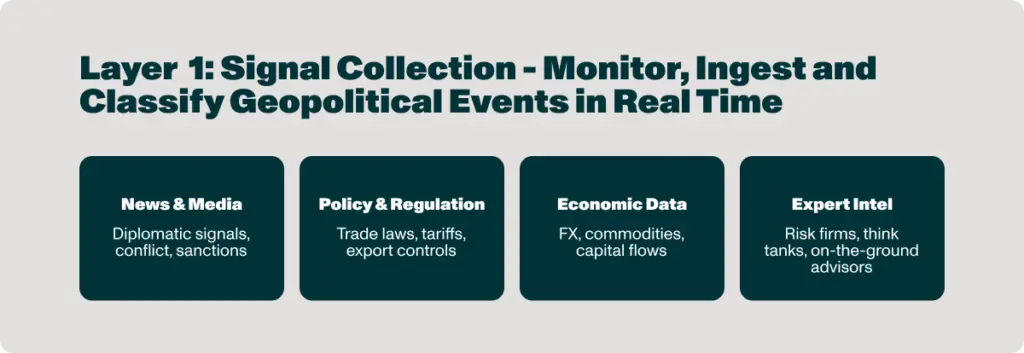
1. Monitoring: Systemic signal detection
The foundation is a systematic, automated monitoring capability that harvests, aggregates, and filters signals from a wide variety of sources: news flows, policy developments, economic indicators, regulatory changes, and curated expert intelligence networks. The objective is not to collect an ever-expanding amount of information, but to cut through noise and surface what matters.
The key discipline here is classification and scoring. Raw signals must be tagged by event type (trade policy, political transition, military escalation, regulatory shift, currency movement) and scored for relevance to the enterprise’s specific footprint. A port dispute in a country where you have no suppliers is background noise. The same dispute at a chokepoint through which 30% of your components transit is a Tier 1 alert.
Technology makes this scalable in ways that were not possible a decade ago. Large language models can now process vast volumes of unstructured text — parliamentary debates, central bank minutes, local-language media — and flag material changes with reasonable precision. But the architecture must be purpose-built: generic news aggregators will not do. The signal-to-noise ratio must be actively managed, or the system becomes another source of overwhelm rather than clarity.
2. Analysis: Connecting signals to business impact
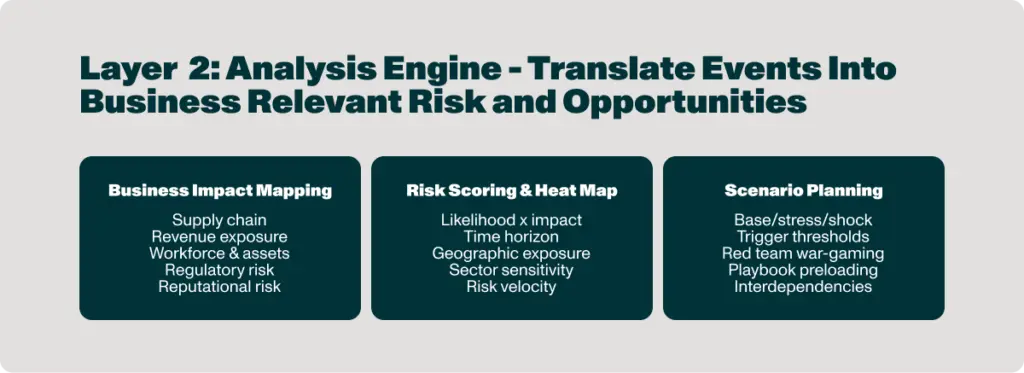
Raw signal is not insight. The second layer is where human analysts, supported by AI-assisted synthesis, transform monitored events into business-relevant intelligence. This is where the work gets harder and more valuable.
Three analytical outputs matter most here. The first is business impact mapping: connecting a geopolitical event directly to the company’s specific exposures — particular supply routes, revenue-generating markets, workforce locations, regulatory dependencies. Generic country-risk scores are largely useless; what matters is the intersection of the event with your specific operational geography.
The second output is dynamic risk scoring: a living heat map that rates threats by likelihood, impact magnitude, time horizon, and velocity — how fast a risk is evolving from theoretical to operational. A risk that is high-impact but slow-moving is managed differently from one that is moderate-impact but accelerating. Static annual risk rankings cannot capture this.
The third output is scenario planning with pre-loaded playbooks. This is perhaps the most underutilized tool in corporate risk management. The goal is not to predict which scenario will materialize — it is to ensure that when a scenario does materialize, the organization is not starting the response from scratch under pressure. Pre-loaded playbooks mean that the decision to activate a supplier diversification strategy, invoke a force majeure clause, or accelerate a market exit has already been thought through. The execution clock starts much earlier.
3. Action: Compressing the decision window
The third layer is where most corporate geopolitical risk programs fail entirely, and it is arguably the most important. Intelligence that does not reach decision-makers in usable form at the right moment has no value. An elegant risk heat map reviewed once a quarter by the general counsel is not a decision-support tool.
Closing this gap requires three things. First, routing: intelligence outputs must be connected directly to the functions that own the relevant decisions. Supply chain disruption signals go to procurement and operations leadership in real time, not into a monthly report. Market access risks go to the strategy and business development teams before capital is committed, not after.
Second, format: intelligence must be delivered in the language of business decisions, not geopolitical analysis. Decision-makers do not need a history of the South China Sea dispute — they need to know what the probability of disruption to their Taiwan-based manufacturing is over the next 18 months, what the cost of a 30-day halt would be, and what the three most actionable mitigation options are. The framing must be financial and operational, not geopolitical.
Third, speed: the decision loop must be compressed. In a zero-distance world, the gap between signal and business impact can be measured in days, not quarters. This argues for pre-delegated authority — clear decisions that designated leaders can make unilaterally within defined parameters when a playbook is activated, without convening committees.
The opportunity in others’ unpreparedness
It is worth stating explicitly what this framework enables beyond risk reduction. The companies that build genuine geopolitical intelligence capability are not merely protecting themselves, they are positioning to move when others cannot.
Geopolitical disruption is, by definition, a moment when competitive positions are renegotiated. Contracts get cancelled and re-awarded. Supply relationships are restructured. Market leaders who relied on now-disrupted advantages suddenly look vulnerable. Customers who were locked into relationships, start taking calls from alternatives. Capital that was committed to one geography needs a new home.
The enterprises that have done the analytical work in advance, that have mapped their exposures, pre-identified alternative suppliers, modeled the financial impact of different scenarios, and built the internal authority to act quickly, are the ones that can make decisive moves in those windows. They can acquire distressed assets, lock in long-term supplier contracts at favorable rates, or accelerate market entries that competitors are retreating from.
Geopolitical volatility, handled well, is a source of strategic advantage, not merely a threat to be managed.
Resilience is an organizational choice
Building this three-layer system is not primarily a technology challenge, though technology is a critical enabler. It is a leadership and organizational design challenge. It requires a CEO and board who treat geopolitical risk as a first-order strategic concern. It requires clear ownership and the dismantling of silos that keep risk analysis separated from business decision-making. It requires intellectual honesty about current capabilities.
This is the architecture Valona Intelligence was built around. As the continuous strategic intelligence layer for global manufacturing, Valona combines always-on signal monitoring across 200,000+ sources in 115+ languages with validated financial and trade data — so qualitative signals and quantitative proof arrive together, not weeks apart. The result is intelligence that’s early enough to act on and verified enough to defend. The three layers described here aren’t theoretical. They’re what Valona’s clients use to get ahead of the market shifts their competitors are still reading about in the headlines
The companies that will thrive in a zero-distance world will not be the ones that predicted every disruption. They will be the ones that built the systems to see signals earlier, interpret them more accurately, and act more decisively than their competitors. That is, ultimately, what resilience means in the world we now inhabit.
Wondering where your intelligence function stands today? Take the Valona Intelligence Maturity Calculator to assess your current capabilities across all three layers.
FAQ
Real-time risk signal monitoring is the continuous, automated tracking of geopolitical, regulatory, competitive, and market signals — filtered for business relevance and delivered to decision-makers before events become crises. Unlike periodic risk reviews, it treats disruption as a continuous input rather than a quarterly agenda item.
The gap between geopolitical analysis and business action is where most intelligence programs fail. Effective geopolitical intelligence is routed to the right function, framed in financial and operational terms, and connected to pre-built response playbooks — so when an event occurs, the decision window opens rather than closes.
Scenario planning prepares you for unlikely but high-impact events by thinking through responses in advance. Real-time monitoring tells you which scenario is actually unfolding — and how fast. You need both: the playbooks that scenario planning produces, and the live signal detection that tells you when to activate them.
The monitoring layer can be stood up relatively quickly with the right platform. The harder work — business impact mapping, dynamic risk scoring, pre-loaded playbooks, and decision routing — is an organizational design challenge that benefits from external expertise, particularly for companies building this capability for the first time.