
What is market intelligence?
Market intelligence helps organizations understand markets, customers, and competitors to make better strategic decisions.
What is market intelligence?
Market intelligence is the systematic process of gathering, analyzing, and applying insights about markets, customers, competitors, suppliers, and the broader business environment. It enables organizations to make better business decisions by understanding how markets are evolving, identifying emerging opportunities and risks, and anticipating the external forces that shape long-term success.
The terms market intelligence and competitive intelligence are sometimes used interchangeably, and their usage varies across industries and regions. Both disciplines help organizations stay competitive and make better strategic decisions. In this guide, we use market intelligence to describe the broader discipline of understanding the external business environment. Competitive intelligence focuses specifically on competitors and competitive dynamics, while market intelligence also incorporates customer insights, industry developments, regulation, geopolitics, supply chains, technology, and other external forces.
Market intelligence supports decisions across multiple time horizons. It helps leaders respond to immediate market developments while identifying longer-term trends that may reshape industries. These insights also provide a foundation for strategic foresight, enabling organizations to explore future scenarios and make more resilient long-term decisions.
Why is market intelligence important?
Organizations today operate in an increasingly uncertain business environment. A recent global study found that 82% of companies operate in an uncertain or unpredictable environment, while 84% do not feel confident in their ability to anticipate what’s coming next. These findings highlight a growing challenge for business leaders: making strategic decisions despite constant change. Source: World Economic Forum & McKinsey, 2025
Market intelligence reduces that uncertainty by providing a continuous understanding of customers, competitors, markets, suppliers, and the broader external environment. Instead of relying on periodic research, organizations can monitor emerging trends, identify risks earlier, and make more informed decisions about growth, innovation, investment, and long-term strategy.
How does market intelligence work?
Market intelligence is a continuous process of gathering, analyzing, and applying information about the external business environment. Rather than relying on isolated research projects, organizations combine insights from customers, competitors, suppliers, markets, technology, regulation, economic developments, and other external forces to build a comprehensive understanding of the factors shaping their business.
Unlike one-off research activities, market intelligence is embedded into ongoing decision-making. It supports both short-term operational decisions and longer-term strategic planning by helping organizations monitor change, identify emerging opportunities and risks, and anticipate how markets may evolve over time. These longer-term insights also provide an important foundation for strategic foresight.
What’s the difference between market intelligence and market research?
Market intelligence and market research are closely related but serve different purposes. Market research is typically conducted to answer a specific business question, such as evaluating a new market, testing a product concept, or understanding customer needs. It provides focused insights at a particular point in time.
Market intelligence builds on that foundation by continuously monitoring customers, competitors, suppliers, markets, and broader external developments. Rather than answering a single question, it helps organizations maintain an up-to-date understanding of the business environment, identify emerging opportunities and risks, and anticipate changes that may require action.
The two approaches are complementary. Organizations often use market research to investigate specific opportunities or challenges, while market intelligence combines those insights with ongoing monitoring of competitors, industry developments, technology, regulation, and other external forces to support strategic decision-making as market conditions evolve.
What are the different types of market intelligence?
Market intelligence encompasses a broad range of intelligence disciplines that help organizations understand the external business environment. The way these disciplines are organized varies between organizations. However, most market intelligence capabilities combine several complementary areas to build a comprehensive view of customers, competitors, markets, suppliers, and the political, economic, technological, and regulatory forces shaping them.
Competitive intelligence
Competitive intelligence focuses on understanding competitors, their strategies, capabilities, products, partnerships, and market positioning. It includes activities such as competitor benchmarking, monitoring competitive moves, and developing battlecards. These activities help organizations anticipate competitor actions, identify opportunities for differentiation, and make better strategic decisions.
Product intelligence
Product intelligence examines products throughout their lifecycle by monitoring customer feedback, competitor offerings, pricing, product launches, and technology developments. These insights help organizations prioritize innovation, refine product roadmaps, and make better portfolio and investment decisions.
Market understanding
Market understanding provides a broad view of the external environment by analyzing market size, growth, segmentation, value chains, industry structure, technology adoption, regulation, economic conditions, and geopolitical developments. It helps organizations assess market attractiveness, identify emerging opportunities, and anticipate changes that may influence future demand.
Customer understanding
Customer understanding examines customer needs, purchasing behavior, decision-making criteria, and evolving expectations. These insights support product development, marketing, customer experience, and long-term growth by ensuring organizations align their offerings with changing customer needs.
Supplier intelligence
Supplier intelligence helps organizations evaluate supplier capabilities, performance, financial health, and potential risks. It supports strategic sourcing, procurement decisions, supply chain resilience, and a better understanding of supplier ecosystems.
Strategic foresight
Strategic foresight builds on market intelligence to explore long-term trends, uncertainties, and alternative future scenarios. It helps organizations anticipate change, evaluate strategic options, and make more resilient long-term decisions in an increasingly uncertain business environment.
How do organizations use market intelligence?
Market intelligence supports decision-making across many business functions. Organizations use it to evaluate growth opportunities, reduce risk, improve commercial performance, and anticipate market changes. The examples below illustrate some of the most common applications.
Market entry and expansion
Entering a new market requires more than understanding customer demand. Organizations also need visibility into competitors, regulatory requirements, local partnerships, supply chains, pricing, and macroeconomic conditions. Market intelligence brings these insights together to help businesses assess market attractiveness, identify barriers to entry, and prioritize expansion opportunities while reducing investment risk.
Product innovation
Successful product innovation depends on understanding customer needs, competitor offerings, technology trends, pricing dynamics, and industry developments. Market intelligence combines these perspectives to reduce uncertainty and help teams optimize product features, positioning, launch timing, and go-to-market strategy.
Strategic growth
Market intelligence supports strategic growth by helping organizations identify attractive markets, customer segments, and investment opportunities. Combining external market intelligence with internal business data enables organizations to prioritize investments, evaluate acquisition or partnership opportunities, and allocate resources more effectively.
For example, organizations often combine external intelligence with internal business data like sales performance, CRM data, and win-loss analysis to identify customer segments where demand is growing but competitive pressure remains relatively low.
Competitive positioning
Competitive positions rarely change overnight. Continuous market intelligence helps organizations identify emerging competitors, substitute solutions, disruptive technologies, regulatory changes, and shifts in customer demand before they materially affect the business. This allows leaders to respond proactively instead of reacting after market conditions have changed.
Operational resilience
Operational resilience depends on understanding risks beyond your own organization. Market intelligence helps teams monitor supply chain risks, regulatory developments, raw material availability, supplier ecosystems, and geopolitical events that may affect business continuity.
Commercial execution
Sales, account and marketing teams use market intelligence to identify new business opportunities, prioritize target accounts, and engage prospects earlier in the buying process. By monitoring investment announcements, facility expansions, partnerships, procurement activity, and other market signals, they can identify demand before opportunities become widely known.
Case study: How a leading Nordic manufacturer expanded its sales pipeline
A leading Nordic manufacturer of industrial equipment wanted to identify new sales opportunities in international markets, including Brazil, where language barriers and fragmented local information made it difficult to identify customer investments early.
Using Valona’s market intelligence platform, regional sales teams received timely alerts on plant expansions, capital investments, facility upgrades, and partnerships from specialized manufacturing sources and local news, automatically translated into English. These signals helped sales teams identify organizations likely to invest in new industrial equipment before those opportunities became widely visible.
The result: More than 500 qualified sales leads were generated within the first three months, transforming the company’s approach to international lead generation.
How do market intelligence platforms support decision-making?
As the volume and complexity of external information continue to grow, many organizations are moving beyond spreadsheets and point solutions to dedicated market intelligence platforms. These platforms centralize intelligence from multiple sources, automate monitoring, and help teams turn information into actionable insights.
Technology should support your market intelligence strategy, not define it. Before evaluating platforms, organizations should identify the business decisions they want to support, the stakeholders who will use the insights, and the sources they need to monitor.
Modern market intelligence platforms combine customer, competitor, supplier, technology, regulatory, and market intelligence in a single environment. Advances in AI are also helping organizations prioritize signals, identify emerging trends, and accelerate intelligence analysis.
Looking for a detailed comparison? Explore our guide to building the right market and competitive intelligence stack, which explains the different categories of intelligence tools, key evaluation criteria, and how to choose the best solution for your organization.
How to choose the right market intelligence platform
The right market intelligence platform depends on your organization’s priorities, stakeholders, and long-term goals. Rather than comparing feature lists alone, focus on whether a platform supports the business decisions and intelligence capabilities you want to build.
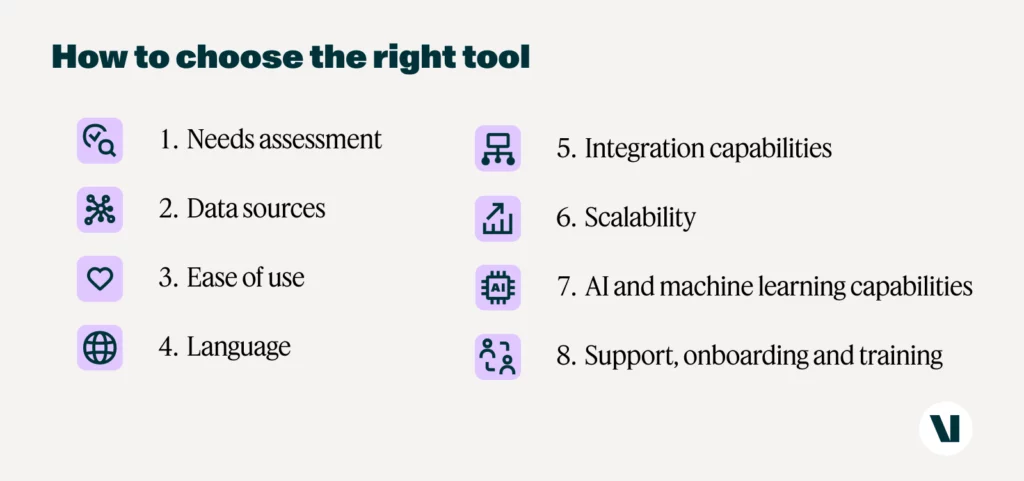
When evaluating market intelligence platforms, consider:
- Business needs – Does the platform support your priority use cases and decision-making needs?
- Data coverage – Can it monitor the markets, competitors, customers, suppliers, and information sources relevant to your business?
- Ease of adoption – Is it intuitive for different teams to use and collaborate?
- Language coverage – Can it monitor and translate the languages and regions that matter to your business?
- Integration capabilities – Does it integrate with your existing workflows, including CRM, BI, collaboration, and enterprise AI tools?
- Scalability – Can it grow with your organization and support multiple business functions?
- AI capabilities – Does the platform offer domain-specific AI capabilities? AI should do more than summarize content. Look for platforms that support multiple workflows and types of analysis.
- Vendor support – What onboarding, training, and ongoing support are available?
Looking for a more detailed evaluation framework? Explore our Competitive & Market Intelligence Platform Buyer’s Guide for practical guidance on comparing vendors, evaluating capabilities, and selecting the right platform.
How do you measure the success of market intelligence?
Building a market intelligence capability is only the first step. To demonstrate business value, organizations need to understand how intelligence influences decisions, supports strategic objectives, and contributes to measurable business outcomes.
The most effective measurement frameworks combine operational metrics, such as intelligence quality, stakeholder engagement, and process efficiency, with business outcomes, including improved decision-making, faster responses to market changes, revenue growth, successful product launches, and risk reduction.
For organizations building or expanding a market intelligence capability, success starts with a clear business case. Defining expected business outcomes before implementation makes it easier to measure impact, demonstrate return on investment, and continuously improve the capability over time.
Continue exploring:
Measuring market intelligence success with KPIs – Explore practical metrics for evaluating intelligence maturity, business impact, and return on investment.
Building the business case for a market intelligence platform – Learn how to quantify the cost of fragmented intelligence, identify measurable value drivers, and build a compelling investment case using seven evidence-based data sources.
FAQ: Market intelligence
Market intelligence provides a broad understanding of the external business environment, including customers, competitors, suppliers, markets, technology, regulation, and economic trends. Competitive intelligence is one component of a broader market intelligence capability. It focuses specifically on competitors, their strategies, capabilities, and competitive positioning.
Market intelligence analyzes the external business environment, while business intelligence analyzes an organization’s internal performance.
Market intelligence helps organizations understand customers, competitors, markets, suppliers, and external trends that influence future decisions. Business intelligence focuses on internal data such as sales, finance, operations, customer transactions, and operational KPIs to measure business performance.
The two disciplines are complementary. Market intelligence explains what is happening outside the organization, while business intelligence explains what is happening inside it. Together, they help organizations make better strategic and operational decisions.
Market intelligence is collected from a wide range of internal and external sources, including customer feedback, competitor websites, annual reports, earnings calls, industry publications, analyst research, news, regulatory filings, government data, trade associations, suppliers, and market intelligence platforms. The most effective organizations combine multiple sources and continuously monitor the external environment rather than relying on one-off research.
A market intelligence platform helps organizations collect, monitor, analyze, and share intelligence from multiple external sources in one place. It automates routine monitoring, supports intelligence analysis, and helps decision-makers identify emerging opportunities, risks, and market trends more efficiently.